
Guía de diseño de iluminación con mástiles altos para atletismo | Distribución de la iluminación y normas de iluminancia para diferentes tamaños de pistas, todo en un solo artículo
Como diseñador de iluminación de mástiles altos para pistas de atletismo, a menudo me preguntan: “En el caso de las mismas pistas de atletismo, ¿por qué algunas tienen una iluminación brillante y uniforme, mientras que otras presentan zonas oscuras y reflejos?”
La respuesta es sencilla: el diseño de la iluminación no es “único para todos”. El principio fundamental es “adaptar la iluminación al tamaño de la pista y ajustarla al uso previsto”. Las dimensiones de las pistas varían considerablemente, desde las pistas estándar de 400 m para competiciones profesionales hasta las pistas no estándar de 300 m y 200 m que se utilizan habitualmente en escuelas y comunidades. Cada tamaño tiene especificaciones claras en cuanto a la disposición de la iluminación, los requisitos de iluminancia y la selección de luminarias. Este artículo cubre todo el tema a fondo, por lo que, ya sea que estés diseñando una nueva instalación o modernizando una existente, puedes consultarlo y aplicarlo directamente.
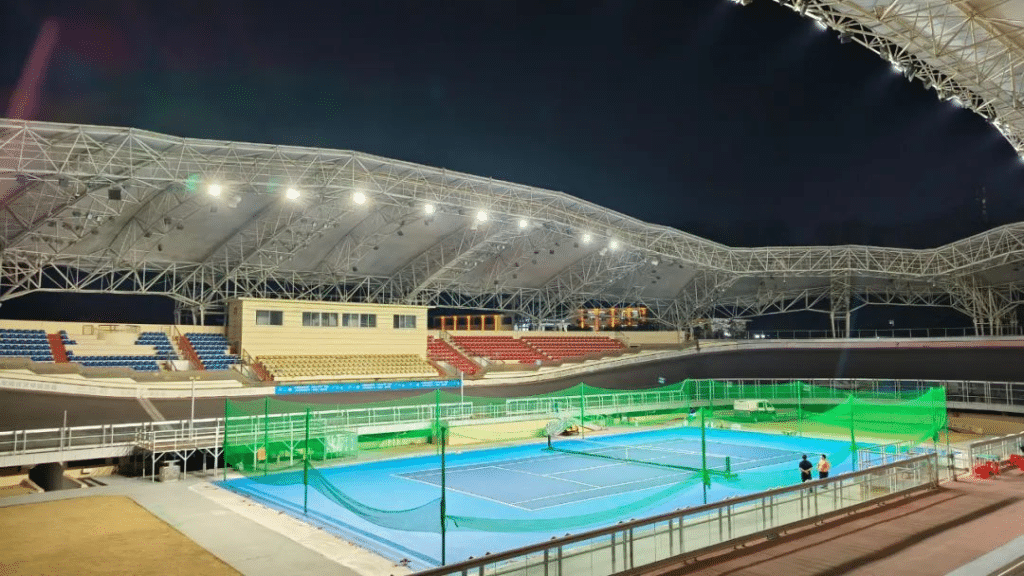
En primer lugar, iluminación de mástil alto para atletismo: Aclaración del requisito previo básico: Clasificación de las pistas de atletismo (por tamaño y uso)
En primer lugar, hay que distinguir el tipo de pista. Los distintos tipos de pista tienen diferentes requisitos básicos de iluminación: las competiciones profesionales exigen una iluminación homogénea y sin fisuras, mientras que las instalaciones escolares o comunitarias buscan un equilibrio entre la eficiencia energética y la practicidad. Según las normas pertinentes de la Asociación China de Atletismo, se dividen principalmente en las tres categorías siguientes, que son también los objetivos fundamentales de nuestro diseño de iluminación:
- Instalaciones de categoría I (nivel de competición profesional): Pista estándar de 400 m, con un radio de curva de 36,5 m (preferiblemente), con al menos 8 carriles en las curvas y 8 carriles en las rectas. Se utiliza para albergar diversas competiciones profesionales de atletismo, lo que exige los más altos estándares de iluminación para satisfacer las necesidades de la retransmisión en alta definición y un arbitraje preciso.
- Instalaciones de categoría II (nivel de entrenamiento e instrucción): Pista ovalada de 400 m, con al menos seis carriles en las curvas. Se utiliza principalmente para el entrenamiento diario en escuelas e instalaciones deportivas, aunque también acoge competiciones a pequeña escala. La iluminación debe garantizar la visibilidad durante el entrenamiento y el confort visual.
- Instalaciones de categoría III (nivel de ocio y fitness): Pistas no estándar (principalmente de 300 m y 200 m), con al menos cuatro carriles ovalados. Son habituales en comunidades y escuelas pequeñas. Los requisitos fundamentales son una iluminación básica, la eficiencia energética y la durabilidad, sin zonas de sombra significativas.
Esto es lo más importante: plano detallado de la iluminación + normas de iluminancia para diferentes tamaños de pista
La esencia del diseño de iluminación consiste en “alcanzar una iluminancia estándar y uniformidad sin deslumbramiento”. La iluminancia (lux) es un indicador clave: representa la cantidad de flujo luminoso recibido por unidad de superficie; cuanto mayor sea el valor, más intensa será la luz. La uniformidad determina si existen diferencias de intensidad luminosa en todo el recinto, lo que evita discrepancias visuales para los atletas y los oficiales. A continuación se presenta un desglose detallado de los aspectos de diseño en función del tamaño de la pista, al que los diseñadores pueden recurrir directamente.
I. Pista estándar de 400 m (instalaciones de categoría I/II) — Diseño de iluminación de nivel profesional
La pista estándar de 400 m es el tipo más común y se divide en dos versiones: la de competición profesional (Categoría I) y la de entrenamiento y formación (Categoría II). Las principales diferencias en el diseño de la iluminación entre ambas residen en la iluminancia y la configuración de las luminarias, mientras que la lógica de la disposición sigue siendo la misma.
1. Principios de diseño de la iluminación
Adopte un enfoque basado en una “disposición de mástiles altos en las cuatro esquinas como sistema principal, complementado con iluminación lateral”, para garantizar una cobertura total y una iluminación uniforme, evitando así la aparición de puntos oscuros en las uniones entre curvas y rectas.
- Ubicación del poste: Se colocarán en las cuatro esquinas de la pista de atletismo, a una distancia de entre 5 y 8 metros del borde de la pista, para no obstaculizar la visibilidad ni el movimiento de los atletas. Si el recinto es grande (Categoría I), se añadirán entre 2 y 4 mástiles altos auxiliares fuera de las calles rectas para complementar la iluminancia en los extremos de las rectas.
- Altura del poste: ¡Un parámetro clave! En las instalaciones de categoría I (competiciones profesionales), la altura del poste debe ser de 25 a 30 m; en las de categoría II (entrenamiento y formación), de 20 a 25 m, asegurándose de que la luz cubra de manera uniforme toda la pista y reduzca la superposición de sombras.
- Ángulo de la luminaria: Ángulo de proyección de 15° a 25°, sin que el ángulo de proyección hacia el borde de la pista supere los 75°. Utilice luminarias de tipo ’cut-off» para evitar que la luz incida directamente en los ojos de los atletas y controle estrictamente el deslumbramiento.
2. Normas de iluminancia (Fundamental, lectura obligatoria)
Clasificados según el escenario de uso, en consonancia con la Asociación China de Atletismo y las normas de diseño de iluminación, para adaptarse con precisión a las diferentes necesidades.
| Tipo de recinto | Escenario de uso | Iluminancia horizontal media (lux) | Uniformidad de la iluminancia | Índice de deslumbramiento (GR) |
|---|---|---|---|---|
| Categoría I (400 m profesional) | Competición profesional + Retransmisión en alta definición | ≥ 1500 | ≥ 0,7 | ≤ 50 |
| Categoría I (400 m profesional) | Entrenamiento diario | 500 – 1000 | ≥ 0,6 | ≤ 55 |
| Categoría II (Formación en 400 m) | Entrenamiento + Pequeñas competiciones | 300 – 500 | ≥ 0,5 | ≤ 55 |
3. Recomendaciones para la selección de luminarias
Se recomienda dar prioridad a las fuentes de luz LED, buscando un equilibrio entre la eficiencia energética y la durabilidad. Los parámetros específicos deben ajustarse a las necesidades del recinto:
- Potencia: La potencia total por poste para las instalaciones de categoría I es de 800 a 1200 W; para las de categoría II, de 600 a 800 W. Utilice un diseño modular que permita la sustitución de módulos individuales, lo que reducirá los costos de mantenimiento.
- Eficiencia luminosa y rendimiento cromático: Eficiencia luminosa ≥ 150 lm/W, índice de reproducción cromática (Ra) ≥ 80 (Ra ≥ 90 para competiciones profesionales), reproduce con precisión los colores de la pista y los tonos de piel de los atletas, apto para retransmisiones en alta definición.
- Protección contra la entrada de elementos: ≥ IP67, lo que garantiza resistencia al agua, al polvo y a la corrosión para su uso en exteriores. Además, cuenta con un sistema inteligente de disipación del calor con control de temperatura para prolongar la vida útil de la luminaria.
II. Pista no reglamentaria de 300 m (instalación de categoría III) — Diseño de iluminación de grado práctico
Las pistas de 300 m se utilizan principalmente en escuelas y comunidades, con radios de curva más pequeños (normalmente de 25 a 30 m) y carriles de unos 1,22 m de ancho. El diseño de la iluminación se centra en “la practicidad, la eficiencia energética y la ausencia de puntos oscuros”, sin buscar en exceso una alta iluminancia.
1. Principios de diseño de la iluminación
Adopta una “disposición simétrica en ambos lados”, lo que elimina la necesidad de mástiles altos en las cuatro esquinas, simplifica la disposición y reduce los costos, por lo que resulta adecuado para las necesidades de recintos pequeños.
- Ubicación del poste: Dispuestos simétricamente a lo largo de los lados exteriores de los bordes largos de la pista, con 3-4 postes por lado, separados entre sí por una distancia de 30-40 m (la distancia entre postes es de 3 a 4 veces la altura de los mismos), cubriendo toda la pista.
- Altura del poste: 15-20 m; no es necesario una altura excesiva para evitar el desperdicio de luz y reducir la contaminación lumínica.
- Ángulo de la luminaria: Ángulo de proyección de 20°-30°, diseñado para cubrir las uniones entre curvas y rectas y evitar así las zonas sin iluminación.
2. Normas de iluminancia
No es necesario cumplir con los estándares de competición profesional; debe adaptarse a situaciones de uso cotidiano:
- Actividad física diaria, actividades recreativas: Iluminancia horizontal media: 100-200 lux; uniformidad ≥ 0,4.
- Formación escolar básica, pequeñas competiciones recreativas: Iluminancia horizontal media: 200-300 lux; uniformidad ≥ 0,5.
- Índice de deslumbramiento (GR) ≤ 60, para evitar el deslumbramiento intenso y garantizar la seguridad en la práctica deportiva.
3. Recomendaciones para la selección de luminarias
Opte por luminarias LED de bajo consumo para controlar los costos y satisfacer al mismo tiempo las necesidades de uso.
- Potencia: Potencia total por poste: 300-500 W; admite regulación de intensidad en función del tiempo y funciona a baja potencia para el uso diario con el fin de ahorrar energía.
- Eficiencia luminosa y rendimiento cromático: Eficiencia luminosa ≥ 140 lm/W, índice de reproducción cromática (Ra) ≥ 75, suficiente para identificar claramente las marcas de la pista.
- Protección contra la entrada de elementos: ≥ IP65, lo que garantiza una protección básica contra el agua y el polvo para su uso en exteriores, sin necesidad de configuraciones de gama alta.
III. Pista no reglamentaria de 200 m (instalación de categoría III) — Diseño de iluminación de nivel básico
Las pistas de 200 metros se utilizan principalmente en escuelas pequeñas y en instalaciones deportivas comunitarias; suelen tener una circunferencia corta y una anchura reducida (normalmente 4 carriles). El diseño de la iluminación se centra en “la iluminación básica, la simplicidad y la durabilidad”, sin diseños complejos.
1. Principios de diseño de la iluminación
Adopta una “disposición sencilla, ya sea a una sola cara o a doble cara”, que se pueda adaptar con flexibilidad al tamaño del recinto, centrándose en cubrir las zonas principales del circuito.
- Ubicación del poste: 2-3 postes dispuestos en un solo lado, o 2 postes simétricamente a ambos lados, situados a una distancia de 3-5 m del borde de la pista para no ocupar espacio en el recinto.
- Altura del poste: 12-15 m, ideal para salas pequeñas, ya que garantiza que la luz cubra toda la pista sin zonas de sombra significativas.
- Ángulo de la luminaria: Ángulo de proyección de 30°-40°, con el uso de lentes de haz amplio (120°-150°) para ampliar el alcance de la iluminación y reducir el número de luminarias.
2. Normas de iluminancia
Satisfacen las necesidades básicas de uso; no es necesario un alto nivel de iluminancia para evitar el desperdicio de energía.
- Ejercicio diario, Caminar: Iluminancia horizontal media: 50-100 lux; uniformidad ≥ 0,3.
- Formación básica para alumnos de primaria: Iluminancia horizontal media: 100-150 lux; uniformidad ≥ 0,4.
- Índice de deslumbramiento (GR) ≤ 65, para no poner en riesgo la seguridad de las personas mayores y los niños al practicar deporte.
3. Recomendaciones para la selección de luminarias
Elija luminarias LED económicas y prácticas, dando prioridad al control de costos y a la facilidad de mantenimiento.
- Potencia: Potencia total por poste: 200-300 W; compacto y liviano; fácil de instalar y mantener.
- Eficiencia luminosa y rendimiento cromático: Eficiencia luminosa ≥ 130 lm/W, índice de reproducción cromática (Ra) ≥ 70, suficiente para identificar claramente la pista.
- Protección contra la entrada de elementos: ≥ IP65, lo que garantiza una protección básica contra el agua para entornos exteriores, dando prioridad a la relación calidad-precio.
Lectura imprescindible para diseñadores: Precauciones generales (Guía para evitar errores)
Independientemente del tamaño de la pista, el diseño de la iluminación debe respetar los siguientes cuatro puntos para evitar problemas y garantizar la eficacia de la iluminación y la seguridad en su uso:
- El control del deslumbramiento es fundamental: Ya sea en instalaciones profesionales o básicas, evite que la luz incida directamente en los ojos de los atletas y los árbitros. Dé prioridad a las luminarias de corte con un ángulo de protección ≥ 40°, combinadas con carcasas con deflectores profundos para reducir el deslumbramiento.
- La uniformidad tiene prioridad sobre la iluminancia: Es mejor tener una iluminancia ligeramente inferior que presentar diferencias de luminosidad. Utilice un programa de simulación de iluminación como DIALux para realizar modelos fotométricos en 3D y optimizar así la ubicación de los postes y los ángulos de las luminarias.
- Combina la eficiencia energética con la inteligencia: Priorice las fuentes de luz LED, que permiten la regulación de la intensidad según las necesidades y el control por horarios. Ajuste el brillo según los distintos usos (entrenamientos, competiciones, actividades recreativas) para reducir los costos operativos.
- La protección de la seguridad es esencial: Instale dispositivos de protección contra rayos en la parte superior de los postes, con una resistencia de puesta a tierra inferior a 10 Ω. Las luminarias deben contar con diseños que eviten caídas y cortocircuitos. Utilice cables flexibles resistentes a la tracción y al envejecimiento para garantizar la seguridad en exteriores.
Consejo: El diseño de la iluminación debe adaptarse de manera integral en función de las dimensiones reales de la pista, el uso del recinto y el entorno circundante. Las indicaciones anteriores son normas generales. Se pueden desarrollar soluciones personalizadas en función de las condiciones específicas del recinto (por ejemplo, la presencia de gradas o la sombra proyectada por los edificios circundantes). Como diseñador, se recomienda realizar primero un modelo utilizando un software de simulación de iluminación antes de finalizar el plano de distribución, a fin de garantizar que la eficacia de la iluminación cumpla con las normas.
Conclusión
La clave del diseño de la iluminación con mástiles altos para pistas de atletismo es la “adaptación”: adaptarse al tamaño de la pista, al uso previsto y al presupuesto. En el caso de las pistas de 400 m de nivel profesional, se debe buscar una alta iluminancia y una gran uniformidad. En cuanto a las pistas de 300 m y 200 m de escuelas y comunidades, hay que encontrar un equilibrio entre la practicidad y la eficiencia energética.
Al dominar los principios de diseño y las normas de iluminancia mencionados anteriormente, ya sea que estés diseñando un nuevo espacio o renovando uno ya existente, podrás obtener resultados de manera eficiente y evitar contratiempos. Si necesitas una solución de iluminación personalizada basada en las dimensiones específicas del espacio (como el radio de curva personalizado o el número de carriles), no dudes en consultarnos.
¡Guarda este artículo, utilízalo como referencia directa para tu próximo proyecto y gestiona fácilmente la iluminación de mástiles altos para pistas de atletismo de diferentes tamaños!
✨ Diseño profesional de iluminación para pistas de atletismo, que garantiza que cada carrera se vea con claridad y luminosidad ✨
Preguntas frecuentes sobre Amasly Light
P1.¿Puedo recibir un pedido de muestra de luz led?
R: Sí, aceptamos pedidos de muestras para probar y comprobar la calidad. Las muestras mezcladas son aceptables.
P2: ¿Y el plazo de entrega?
R: La muestra necesita 3-5 días, el tiempo de producción en masa necesita 1-2 semanas.
Q3.Do usted tiene cualquier límite MOQ para la luz led orden?
R: Bajo MOQ 1pc para la comprobación de la muestra está disponible.
Q4. ¿Cómo envían la mercancía y cuánto tarda en llegar?
R: Normalmente enviamos por DHL, UPS, FedEx o TNT. El envío suele tardar entre 3 y 5 días en llegar. También se ofrece la opción de envío aéreo y marítimo.
Q5. ¿Cómo tramitar un pedido de luz led?
A:
En primer lugar, comuníquenos sus necesidades o su solicitud.
En segundo lugar, presupuestamos según sus requisitos o nuestras sugerencias.
En tercer lugar, el cliente confirma las muestras y realiza el depósito para el pedido formal.
En cuarto lugar, organizamos la producción.
P6.¿Puedo imprimir mi LOGO en producto de luz led ?
R: Sí, por favor infórmenos formalmente antes de nuestra producción y confirmar el diseño en primer lugar sobre la base de nuestra muestra.
P7: ¿Ofrecen garantía para los productos?
R: Sí, ofrecemos de 2 a 5 años de garantía para nuestros productos.
P8: ¿Cómo tratar los fallos?
A:
En primer lugar, nuestros productos se producen dinstrict sistema de control de calidad y la tasa de defectos será inferior a 0,2%
En segundo lugar, durante el período de garantía, proporcionaremos piezas para sustituir la pieza defectuosa.. Para los pedidos al por mayor, proporcionaremos piezas vulnerables por adelantado, o podemos discutir soluciones, incluyendo la retirada del mercado sobre la base de la situación real.
P9: ¿Podemos fabricar lámparas antideflagrantes de bajo voltaje con voltajes CA/CC de 12 V, 24 V, 36 V o 48 V?
Amasly se puede utilizar como luminaria antideflagrante tanto de baja como de alta tensión: CA/CC 12 V, 24 V, 36 V, 48 V, CA 85-265 V, CA 380 V.
P10: ¿Se pueden añadir baterías de emergencia Explosion Poof Lights?
La lámpara a prueba de explosiones Amasly puede equiparse con baterías de litio de emergencia. La duración de la emergencia es de 90 minutos, 120 minutos o 180 minutos.
P11: ¿Se puede personalizar la lámpara a prueba de explosiones Amasly como producto OEM?
Las lámparas a prueba de explosiones de Amasly se pueden personalizar según los requisitos del cliente, tanto en lo que respecta a las lámparas como a las cajas de embalaje.
Productos relacionados
 Spanish (Mexico)
  English
  Spanish (Spain)
  Arabic
  German
  French
  Russian
  Italian
  Portuguese
  Romanian
  Greek
Greek  Turkish
  Korean
  Hungarian
  Japanese
  Dutch
Dutch  Bulgarian
  Czech
Czech  Danish
  Slovak
  Ukrainian
  Thai
Thai  Vietnamese
  Indonesian
  Malay
Malay  Tagalog