
Explosion Proof Distribution Box
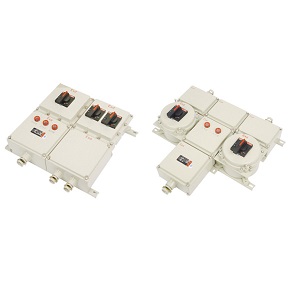
An explosion-proof distribution box is a complete distribution unit designed to house switches, instruments and other equipment in a centralised manner, preventing explosions at the installation site caused by sparks, arcs or high temperatures. Currently, this unit has become an indispensable distribution facility in flammable and explosive environments such as the petrochemical industry.
Based on their explosion-proof design, explosion-proof electrical equipment is primarily classified into flameproof, increased safety, intrinsically safe and positive pressure types. The structure primarily consists of the enclosure and cover, busbar box and cable outlet box, switch knobs, mounting slots, high-breaking-capacity miniature circuit breakers and drive shafts. As explosion-proof distribution boxes are used in harsh environments—particularly those installed outdoors, which are exposed to the elements year-round—the enclosure is typically made of cast aluminium alloy.
The working principle of positive pressure explosion-proof technology in explosion-proof distribution boxes: A distribution box that may possess ignition energy or lacks explosion-proof certification is placed within a positive pressure chamber. A positive pressure ventilation system then fills the chamber with a protective gas, whilst a differential pressure detection system continuously monitors the internal pressure of the distribution box. This ensures that the internal pressure remains higher than the surrounding atmosphere at all times, preventing explosive mixtures from entering the enclosure. Consequently, ignition sources within the distribution box are isolated from flammable gases in the surrounding environment, thereby achieving overall explosion protection for the distribution box.
In the future, explosion-proof distribution boxes will evolve towards greater intelligence, energy efficiency, safety and connectivity. Firstly, the equipment will integrate intelligent control systems, utilising the Internet of Things (IoT), big data and artificial intelligence to enable remote monitoring, fault prediction and automatic handling, thereby enhancing efficiency and safety. Secondly, technology will place greater emphasis on energy efficiency management, utilising energy-saving materials, LED lighting and intelligent dimming to reduce energy consumption and meet green manufacturing requirements.
At the same time, safety performance will continue to improve, with enhanced resistance to electromagnetic interference, fire resistance ratings and environmental adaptability to meet the demands of high-risk industries. Finally, with the development of cloud computing and 5G, explosion-proof distribution boxes will integrate more effectively into the Industrial Internet, enabling efficient coordination between devices and remote operation and maintenance.
Main Categories of Explosion Proof Distribution Boxes
Explosion-proof distribution boxes are categorised as follows: explosion-proof lighting boxes, explosion-proof power distribution boxes, explosion-proof control boxes, explosion-proof control cabinets, explosion-proof distribution cabinets, explosion-proof operating boxes, explosion-proof enclosures, explosion-proof starter boxes, explosion-proof motor starters, explosion-proof soft starters, explosion-proof variable frequency drives, explosion-proof star-delta starter boxes, explosion-proof autotransformer step-down starter boxes, explosion-proof magnetic starters, explosion-proof power socket boxes, portable explosion-proof enclosures, and BMG explosion-proof distribution boxes, amongst others.
Design Standards and Technical Specifications for Explosion Proof Distribution Boxes
Material Selection Standards
As critical electrical equipment for use in special environments, the choice of materials for explosion-proof distribution boxes directly affects the safety and service life of the equipment. For the enclosure and internal components, priority should be given to metal materials with corrosion-resistant and high-temperature-resistant properties; 304 stainless steel or 6061 aluminium alloy are recommended. These two materials not only meet mechanical strength requirements but also exhibit significantly superior oxidation resistance compared to ordinary carbon steel. Specialised explosion-proof cable glands must be fitted at cable entry and exit points. These components should be made of polyurethane composite or fluororubber to ensure elasticity and sealing integrity within a temperature range of -40°C to 120°C.
Structural Design Specifications
The enclosure’s structural design must meet multiple protection requirements: Firstly, double-layer silicone sealing strips should be installed at the enclosure joints, in conjunction with stainless steel anti-loosening bolts, to ensure compliance with IP65 protection rating. Secondly, the wall thickness of the enclosure should be designed according to its volume; typically, enclosures under 20 litres use 2 mm sheet metal, whilst those between 20 and 100 litres use 3 mm sheet metal, with additional internal stiffening ribs. The heat dissipation system design must follow thermodynamic principles; it is recommended to install aluminium heat dissipation fins on non-explosion-proof surfaces, along with explosion-proof axial fans that automatically start and stop based on internal temperature sensors.
Explosion-proof System Configuration
The selection of electrical components must comply with GB3836.1-2010 General Requirements for Equipment for Use in Explosive Atmospheres. It is recommended to use an Exd IIB T4 explosion-proof circuit breaker for the main switch, and Exe II T3 explosion-proof fuses for branch protection. The cable connection system should be equipped with triple protection: an outer layer of stainless steel braided conduit, a middle layer filled with explosion-proof sealing compound, and an inner layer comprising copper explosion-proof cable glands. In particular, at the transition between the enclosure and the cable duct, a labyrinth-type explosion-proof structure must be installed to ensure that explosion pressure can be safely released through pre-set pressure relief channels.
Intelligent Monitoring System
Modern explosion-proof distribution boxes should incorporate intelligent monitoring modules, including but not limited to: a remote monitoring unit based on the MODBUS protocol, capable of collecting parameters such as internal temperature, humidity and insulation resistance in real time; a GSM text message alarm module, which automatically triggers an alarm when a leakage current exceeding 30 mA or a box temperature exceeding 70°C is detected; it is recommended to install an arc flash protection device utilising ultraviolet detection technology, capable of disconnecting the faulty circuit within 5 ms. All monitoring data should be uploaded to the central control system via an intrinsically safe RS485 interface.
Comprehensive Protection Measures
The safety protection system must establish a multi-level protection mechanism: the first level involves controlling the surface resistance of the enclosure’s electrostatic conductive coating to below 10⁶ Ω; The second level involves the installation of Class I, Category C surge protectors with a current-carrying capacity of no less than 40 kA; the third level involves the installation of a thermal aerosol automatic fire extinguishing system, with the activation temperature threshold set at 150°C.
The earthing system shall be made of tin-plated copper, with an earth resistance value not exceeding 4 Ω, and all metal components must be reliably connected via equipotential bonding terminals. In areas prone to frequent lightning strikes, early-discharge lightning rods shall also be installed, with a protection radius covering the entire switchgear area.
These technical specifications have been drawn up with reference to the IEC 60079 series of international standards and the GB 12476 national standard; during implementation, differentiated designs must be adopted in accordance with the classification of hazardous areas (Zone 0, Zone 1, Zone 2) at the specific site. For special industries such as chemicals and petroleum, industry-specific safety certification requirements, such as ATEX or UL certification, must also be met. All design changes must undergo a special review by the Safety Assessment Committee for Electrical Equipment in Explosive Atmospheres.
Indhold
Kontakt
- E-mail: sales01@amasly.com
- Mobil: +86 13732643699
Explosion Proof Distribution Boxes parameters:
Udførelsesstandard: IEC60079
Eksplosionssikkert symbol: Ex d IIC T6 Gb
Rated voltage: AC: 220V, 110V
Beskyttelsesgrad: IP66
Anti-korrosionsklasse: WF2
Ofte stillede spørgsmål om Amasly Light
Q1. Kan jeg få en prøveordre på led-lys?
A: Ja, vi byder prøveordre velkommen til at teste og kontrollere kvaliteten. Blandede prøver er acceptable.
Q2. Hvad med leveringstiden?
A: Prøven tager 3-5 dage, masseproduktionstiden tager 1-2 uger.
Q3.Har du nogen MOQ-grænse for ledet lysordre?
A: Lav MOQ 1pc til prøvekontrol er tilgængelig.
Q4. Hvordan sender I varerne, og hvor lang tid tager det at få dem frem?
A: Vi sender normalt med DHL, UPS, FedEx eller TNT. Det tager normalt 3-5 dage at ankomme. Luftlinje og søfart er også valgfri.
Q5. Hvordan fortsætter man en ordre på led-lys?
A:
Fortæl os først om dine krav eller din ansøgning.
For det andet giver vi tilbud i henhold til dine krav eller vores forslag.
For det tredje bekræfter kunden prøverne og lægger et depositum for den formelle ordre.
For det fjerde arrangerer vi produktionen.
Q6. er det ok at printe min LOGO på led-lys produkt?
A: Ja, informer os venligst formelt inden vores produktion og bekræft først designet baseret på vores prøve.
Q7: Tilbyder du garanti for produkterne?
A: Ja, vi tilbyder 2-5 års garanti på vores produkter.
Q8: Hvordan håndterer man de defekte?
A:
For det første producerer vores produkter dinstrict kvalitetskontrolsystem, og den defekte sats vil være mindre end 0,2%
For det andet vil vi i løbet af garantiperioden levere dele til at erstatte den dårlige del. Ved bulkordrer leverer vi sårbare dele på forhånd, eller vi kan diskutere løsninger, herunder tilbagekaldelser, baseret på den faktiske situation.
Q9: Kan vi lave eksplosionssikre lavspændingslamper med AC/DC-spændinger på 12V, 24V, 36V eller 48V?
Amasly kan bruges som både lavspændings- og højspændings eksplosionssikkert lys - AC/DC 12V, 24V, 36V, 48V, AC 85-265V, AC 380V.
Q10: Kan der tilføjes nødbatterier til Explosion Poof Lights?
Den eksplosionssikre Amasly-lampe kan udstyres med lithium-nødbatterier. Nødvarigheden er 90 minutter, 120 minutter eller 180 minutter.
Q11: Kan Amaslys eksplosionssikre lampe tilpasses som et OEM-produkt?
Amasly eksplosionssikre lamper kan tilpasses efter kundens krav til både lamperne og emballagekartonerne.
Relaterede produkter
 DA
DA  EN
EN  ES
ES  AR
AR  DE
DE  FR
FR  RU
RU  IT
IT  PT
PT  ES_MX
ES_MX  RO
RO  EL
EL  TR
TR  KO
KO  HU_HU
HU_HU  JA
JA  NL
NL  BG
BG  CS
CS  SK
SK  UK
UK  TH
TH  VI
VI  ID
ID  MS
MS  TL
TL