
Explosion Proof Distribution Box
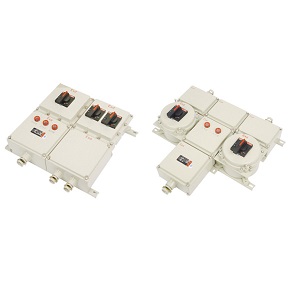
An explosion-proof distribution box is a complete distribution unit designed to house switches, instruments and other equipment in a centralised manner, preventing explosions at the installation site caused by sparks, arcs or high temperatures. Currently, this unit has become an indispensable distribution facility in flammable and explosive environments such as the petrochemical industry.
Based on their explosion-proof design, explosion-proof electrical equipment is primarily classified into flameproof, increased safety, intrinsically safe and positive pressure types. The structure primarily consists of the enclosure and cover, busbar box and cable outlet box, switch knobs, mounting slots, high-breaking-capacity miniature circuit breakers and drive shafts. As explosion-proof distribution boxes are used in harsh environments—particularly those installed outdoors, which are exposed to the elements year-round—the enclosure is typically made of cast aluminium alloy.
The working principle of positive pressure explosion-proof technology in explosion-proof distribution boxes: A distribution box that may possess ignition energy or lacks explosion-proof certification is placed within a positive pressure chamber. A positive pressure ventilation system then fills the chamber with a protective gas, whilst a differential pressure detection system continuously monitors the internal pressure of the distribution box. This ensures that the internal pressure remains higher than the surrounding atmosphere at all times, preventing explosive mixtures from entering the enclosure. Consequently, ignition sources within the distribution box are isolated from flammable gases in the surrounding environment, thereby achieving overall explosion protection for the distribution box.
In the future, explosion-proof distribution boxes will evolve towards greater intelligence, energy efficiency, safety and connectivity. Firstly, the equipment will integrate intelligent control systems, utilising the Internet of Things (IoT), big data and artificial intelligence to enable remote monitoring, fault prediction and automatic handling, thereby enhancing efficiency and safety. Secondly, technology will place greater emphasis on energy efficiency management, utilising energy-saving materials, LED lighting and intelligent dimming to reduce energy consumption and meet green manufacturing requirements.
At the same time, safety performance will continue to improve, with enhanced resistance to electromagnetic interference, fire resistance ratings and environmental adaptability to meet the demands of high-risk industries. Finally, with the development of cloud computing and 5G, explosion-proof distribution boxes will integrate more effectively into the Industrial Internet, enabling efficient coordination between devices and remote operation and maintenance.
Main Categories of Explosion Proof Distribution Boxes
Explosion-proof distribution boxes are categorised as follows: explosion-proof lighting boxes, explosion-proof power distribution boxes, explosion-proof control boxes, explosion-proof control cabinets, explosion-proof distribution cabinets, explosion-proof operating boxes, explosion-proof enclosures, explosion-proof starter boxes, explosion-proof motor starters, explosion-proof soft starters, explosion-proof variable frequency drives, explosion-proof star-delta starter boxes, explosion-proof autotransformer step-down starter boxes, explosion-proof magnetic starters, explosion-proof power socket boxes, portable explosion-proof enclosures, and BMG explosion-proof distribution boxes, amongst others.
Design Standards and Technical Specifications for Explosion Proof Distribution Boxes
Material Selection Standards
As critical electrical equipment for use in special environments, the choice of materials for explosion-proof distribution boxes directly affects the safety and service life of the equipment. For the enclosure and internal components, priority should be given to metal materials with corrosion-resistant and high-temperature-resistant properties; 304 stainless steel or 6061 aluminium alloy are recommended. These two materials not only meet mechanical strength requirements but also exhibit significantly superior oxidation resistance compared to ordinary carbon steel. Specialised explosion-proof cable glands must be fitted at cable entry and exit points. These components should be made of polyurethane composite or fluororubber to ensure elasticity and sealing integrity within a temperature range of -40°C to 120°C.
Structural Design Specifications
The enclosure’s structural design must meet multiple protection requirements: Firstly, double-layer silicone sealing strips should be installed at the enclosure joints, in conjunction with stainless steel anti-loosening bolts, to ensure compliance with IP65 protection rating. Secondly, the wall thickness of the enclosure should be designed according to its volume; typically, enclosures under 20 litres use 2 mm sheet metal, whilst those between 20 and 100 litres use 3 mm sheet metal, with additional internal stiffening ribs. The heat dissipation system design must follow thermodynamic principles; it is recommended to install aluminium heat dissipation fins on non-explosion-proof surfaces, along with explosion-proof axial fans that automatically start and stop based on internal temperature sensors.
Explosion-proof System Configuration
The selection of electrical components must comply with GB3836.1-2010 General Requirements for Equipment for Use in Explosive Atmospheres. It is recommended to use an Exd IIB T4 explosion-proof circuit breaker for the main switch, and Exe II T3 explosion-proof fuses for branch protection. The cable connection system should be equipped with triple protection: an outer layer of stainless steel braided conduit, a middle layer filled with explosion-proof sealing compound, and an inner layer comprising copper explosion-proof cable glands. In particular, at the transition between the enclosure and the cable duct, a labyrinth-type explosion-proof structure must be installed to ensure that explosion pressure can be safely released through pre-set pressure relief channels.
Intelligent Monitoring System
Modern explosion-proof distribution boxes should incorporate intelligent monitoring modules, including but not limited to: a remote monitoring unit based on the MODBUS protocol, capable of collecting parameters such as internal temperature, humidity and insulation resistance in real time; a GSM text message alarm module, which automatically triggers an alarm when a leakage current exceeding 30 mA or a box temperature exceeding 70°C is detected; it is recommended to install an arc flash protection device utilising ultraviolet detection technology, capable of disconnecting the faulty circuit within 5 ms. All monitoring data should be uploaded to the central control system via an intrinsically safe RS485 interface.
Comprehensive Protection Measures
The safety protection system must establish a multi-level protection mechanism: the first level involves controlling the surface resistance of the enclosure’s electrostatic conductive coating to below 10⁶ Ω; The second level involves the installation of Class I, Category C surge protectors with a current-carrying capacity of no less than 40 kA; the third level involves the installation of a thermal aerosol automatic fire extinguishing system, with the activation temperature threshold set at 150°C.
The earthing system shall be made of tin-plated copper, with an earth resistance value not exceeding 4 Ω, and all metal components must be reliably connected via equipotential bonding terminals. In areas prone to frequent lightning strikes, early-discharge lightning rods shall also be installed, with a protection radius covering the entire switchgear area.
These technical specifications have been drawn up with reference to the IEC 60079 series of international standards and the GB 12476 national standard; during implementation, differentiated designs must be adopted in accordance with the classification of hazardous areas (Zone 0, Zone 1, Zone 2) at the specific site. For special industries such as chemicals and petroleum, industry-specific safety certification requirements, such as ATEX or UL certification, must also be met. All design changes must undergo a special review by the Safety Assessment Committee for Electrical Equipment in Explosive Atmospheres.
Contenido
Póngase en contacto con
- Correo electrónico: sales01@amasly.com
- Móvil: +86 13732643699
Explosion Proof Distribution Boxes parameters:
Norma de ejecución: IEC60079
Símbolo antideflagrante: Ex d IIC T6 Gb
Rated voltage: AC: 220V, 110V
Grado de protección: IP66
Grado anticorrosión: WF2
Preguntas más frecuentes sobre Amasly Light
P1.¿Puedo recibir un pedido de muestra de luz led?
R: Sí, aceptamos pedidos de muestras para probar y comprobar la calidad. Las muestras mezcladas son aceptables.
P2: ¿Y el plazo de entrega?
R: La muestra necesita 3-5 días, el tiempo de producción en masa necesita 1-2 semanas.
Q3.Do usted tiene cualquier límite MOQ para la luz led orden?
R: Bajo MOQ 1pc para la comprobación de la muestra está disponible.
Q4. ¿Cómo envían la mercancía y cuánto tarda en llegar?
R: Normalmente enviamos por DHL, UPS, FedEx o TNT. Suele tardar entre 3 y 5 días en llegar. Línea aérea y marítima de envío también opcional.
Q5. ¿Cómo tramitar un pedido de luz led?
A:
En primer lugar, comuníquenos sus necesidades o su solicitud.
En segundo lugar, presupuestamos según sus requisitos o nuestras sugerencias.
En tercer lugar, el cliente confirma las muestras y realiza el depósito para el pedido formal.
En cuarto lugar, organizamos la producción.
P6.¿Puedo imprimir mi LOGO en producto de luz led ?
R: Sí, por favor infórmenos formalmente antes de nuestra producción y confirmar el diseño en primer lugar sobre la base de nuestra muestra.
P7: ¿Ofrecen garantía para los productos?
R: Sí, ofrecemos de 2 a 5 años de garantía para nuestros productos.
P8: ¿Cómo tratar los fallos?
A:
En primer lugar, nuestros productos se producen dinstrict sistema de control de calidad y la tasa de defectos será inferior a 0,2%
En segundo lugar, durante el período de garantía, proporcionaremos piezas para sustituir la pieza defectuosa.. Para los pedidos al por mayor, proporcionaremos piezas vulnerables por adelantado, o podemos discutir soluciones, incluyendo la retirada del producto, en función de la situación real.
P9: ¿Se pueden fabricar lámparas antideflagrantes de bajo voltaje con tensiones de CA/CC de 12 V, 24 V, 36 V o 48 V?
Amasly se puede utilizar como luces a prueba de explosiones tanto de bajo voltaje como de alto voltaje - AC/DC 12V, 24V, 36V, 48V, AC 85-265V, AC 380V.
Q10: ¿Se pueden añadir pilas de emergencia a las luces Poof Explosion?
La lámpara antideflagrante Amasly puede equiparse con baterías de litio de emergencia. La duración de emergencia es de 90 minutos, 120 minutos o 180 minutos.
P11: ¿Se puede personalizar la lámpara a prueba de explosiones Amasly como producto OEM?
Las lámparas antideflagrantes Amasly pueden personalizarse según los requisitos del cliente, tanto para las lámparas como para las cajas de embalaje.
Productos relacionados
 ES
ES  EN
EN  AR
AR  DE
DE  FR
FR  RU
RU  IT
IT  PT
PT  ES_MX
ES_MX  RO
RO  EL
EL  TR
TR  KO
KO  HU_HU
HU_HU  JA
JA  NL
NL  BG
BG  CS
CS  DA
DA  SK
SK  UK
UK  TH
TH  VI
VI  ID
ID  MS
MS  TL
TL