
Learn how to achieve optimal design for golf course lighting
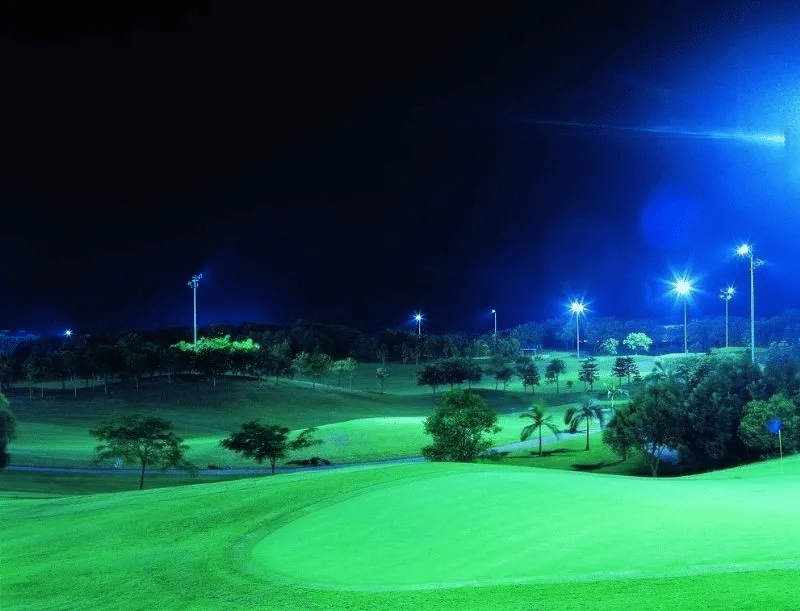
Golf courses are larger than other sports venues, with many fairways and varied terrain, making lighting design on golf courses more complex. However, lighting is key to ensuring that players have a great nighttime playing experience. Therefore, you should definitely read this article to learn how to achieve the best lighting design for your golf course!
How to Lay Out a Para Golf Course Lighting Pole
A golf course consists of three main parts: tees, fairways, and greens, and each area has different lighting requirements.
Tee
The average horizontal illumination value of the main tee area should be higher than 150 lux (Lx); Vertical illumination within the 30-meter height range of the tee: a. Behind the main tee: higher than 100 lux (Lx); b. In front of the tee: higher than 300 lux (Lx); c. 200 meters in front of the tee: higher than 150 lux (Lx).
Fairways
Horizontal and vertical illuminance should be standardized over the entire length of the fairway to provide optimum lighting conditions in hilly areas. The required average horizontal illuminance should be greater than 120 lux (Lx) and the average vertical illuminance should be greater than 50 lux (Lx).
Greens
The greens area should be adequately illuminated and should minimize shadows on the player’s body when hitting the ball from multiple directions. The average horizontal illumination in this area should be greater than 250 Lux (Lx).
The goal of the tee lighting design is to provide a clear view of the ball and the end of the club for both left and right-handed players. Widely distributed floodlights are recommended as lighting fixtures, preferably from both directions. This type of lighting prevents shadows from falling in the direction of the shot or on the ball.
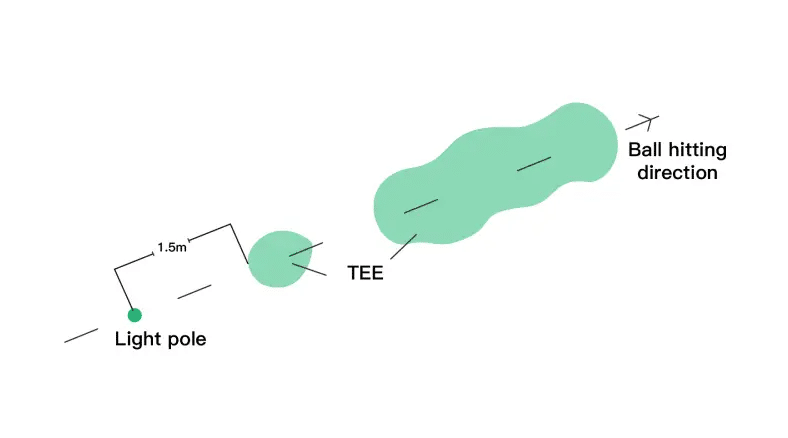
Light poles should normally be placed at least 1.5 meters from the back boundary of the tee. For larger tees, it is necessary to provide illumination from more than one direction. The height of the light pole should not be less than half the total length of the tee and should be at least 9 meters above the tee.
Fairways
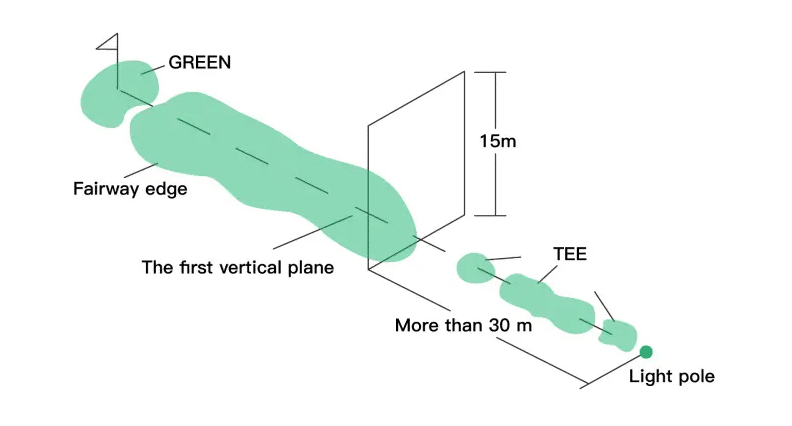
The average fairway width is approximately 41 meters, with the exact width varying depending on the level of recreational challenge. Generally, fairway widths can range from 32 meters to 55 meters. Typical fairways curve at all points around the perimeter and are widest at the drop zone. To achieve adequate vertical illumination, consider using narrowly distributed floodlights from both sides as tracking lighting. The reference value for vertical illumination is taken from a plane perpendicular to the centerline of the fairway at a height of approximately 15 meters above the centerline of the fairway and a length of the full width of the fairway at that location.
The vertical illumination of the fairway should be sufficient to allow the player to see the complete trajectory of the ball until it hits the ground at speeds of up to 100 kilometers per hour. For this purpose, the first vertical plane is required to be not less than 30 meters from the tee light poles. It is preferable to place these lights in the corners of the fairway or in the drop zone, which reduces the number of luminaires. The minimum mounting height for a light fixture is 11 meters from its base. Light poles are usually placed along golf cart paths or on elevated ground to minimize the effect of terrain.
Greens
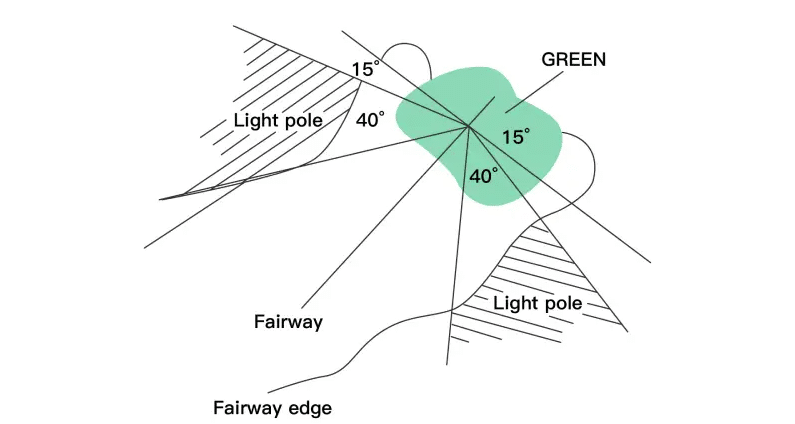
Greens have very high horizontal illumination requirements and the ratio of maximum horizontal illumination to minimum horizontal illumination should not be greater than 3:1. On a golf course, players can hit the ball in any direction towards the hole, so lighting should be provided from at least two directions to minimize shadows. The installation area is a shaded area 40 degrees in front of the green area. The maximum spacing between light fixtures is three times the height of the light pole.
Factors to consider for optimal lighting design on a golf course
Glare Reduction: There are four types of glare to consider: direct glare, reflected glare, contrasting light and dark glare, and glare caused by visual discomfort. For adjacent fairways, direct glare is likely to occur. Glare can be minimized by increasing the height of the glare source when the golfer is at a certain distance from the light source. Experience has shown that glare can be more effectively controlled when the height of the light source exceeds 11 meters.
Choose a light source with high color temperature and high color rendering index (CRI). Using a light source with a color temperature of 5500K or above and a color rendering index greater than 90 can restore the original color of objects such as lawns and balls.
Pole selection: Common pole types include fixed, tilt, pneumatic lift and hydraulic lift. In addition to budget considerations, choose a light pole that minimizes damage to the natural beauty of the golf course.

Although golf courses are larger and more complex than other courses, understanding the criteria can help you take the first steps in golf course lighting design. Then, taking into account the characteristics of the golf game and the various terrains, you can design the lighting for the tee (TEE), fairway (FAIRWAY), green (GREEN) and other areas.
Standard: IEC60598
Related Products
 English
  Spanish (Spain)
  Arabic
  German
  French
  Russian
  Italian
  Portuguese
  Spanish (Mexico)
  Romanian
  Greek
Greek  Turkish
  Korean
  Hungarian
  Japanese
  Dutch
Dutch  Bulgarian
  Czech
Czech  Danish
  Slovak
  Ukrainian
  Thai
Thai  Vietnamese
  Indonesian
  Malay
Malay  Tagalog