
What wattage should be chosen for factory and warehouse High bay lights? Selecting the right power based on the scenario saves energy and ensures practicality.
High bay lights are fixtures used in production areas of factories and mines. Beyond standard lighting for general environments, they also include explosion-proof and corrosion-resistant models for hazardous conditions.
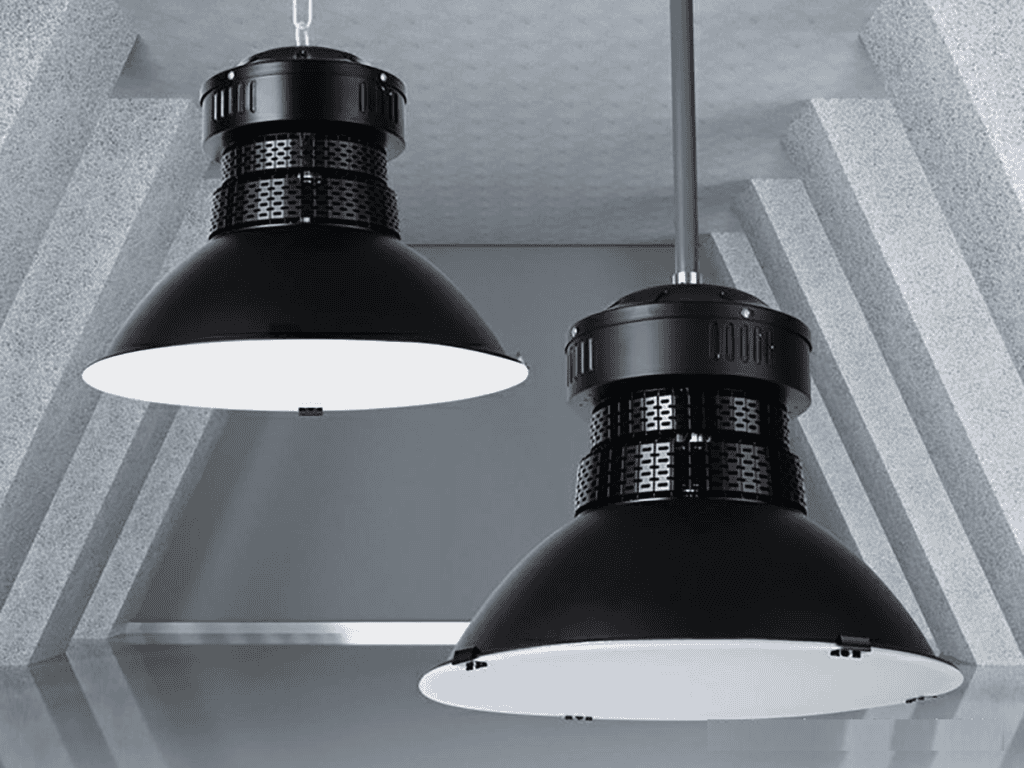
Advantages of LED High bay lights
Based on light source, these fixtures fall into two categories: traditional (e.g., sodium or mercury vapor lamps) and LED. Compared to traditional High bay lights, LED High bay lights offer significant advantages:
1: LED High bay lights feature high color rendering index (CRI) >80, producing pure, color-accurate light without color distortion. They cover the entire visible spectrum and can combine R/G/B to create any desired visible light. Lifespan: LED average lifespan of 5,000–100,000 hours significantly reduces maintenance and replacement costs.
2: LED High bay lights deliver high luminous efficacy and superior energy efficiency. Current laboratory-achieved peak efficacy reaches 260 lm/W, with theoretical maximum efficiency of 370 lm/W. Commercially available products now achieve up to 160 lm/W.
3: Traditional light sources suffer from high fixture temperatures, often reaching 200-300°C. LEDs, however, are cold light sources with low operating temperatures, enhancing safety.
4: Shock Resistance: As solid-state light sources, LEDs possess unmatched shock resistance compared to other lighting products.
5: Stability: 100,000 hours of operation with light output maintaining 70% of initial brightness.
6: Response Time: LEDs achieve nanosecond-level response times, making them the fastest-responding light source available.
7: Environmental Friendliness: Contains no harmful substances like mercury.
As the primary lighting solution for factories and warehouses, selecting the wrong wattage for High bay lights not only wastes electricity and money but may also compromise production safety. Many businesses struggle with the question, “What wattage is typical for High bay lights?” The truth is there’s no one-size-fits-all answer—it depends on the height of the application area and specific operational requirements.
Factory Illuminance Comparison Chart: In accordance with international lighting standards and operational precision requirements, machine shops must implement zoned illuminance management:
Different workshops have varying illuminance requirements. During actual implementation, installation height and spacing should be flexibly adjusted based on workshop illuminance design specifications and the luminous efficacy values of LED industrial lights. Localized enhanced lighting may sometimes be necessary, requiring the selection of LED industrial lights with different power ratings and installation heights.
| Application | Illuminance |
| Precision Work Areas (Quality Inspection, Precision Machining) | 500-1000 lux |
| General Machining Areas (Lathes, Milling Machines, Drilling Machines) | 300-500 lux |
| Material Storage Areas (Aisles, Warehouses) | 100-200 lux |
Analysis of LED High Bay Light Installation Height and Power
Low-height scenarios (5-8 meters), such as electronics assembly workshops or small warehouses, do not require high power. LED High bay lights ranging from 50-150W are sufficient. For instance, a 100W high-efficiency model can achieve over 150LM/W. Paired with an optical lens, a single fixture can cover 30-50㎡, saving over 60% more energy than traditional fixtures.
High Bay Light Installation Height and Power Rating Chart:
| Installation Height | 3-5m | 5-8m | 8-12m | 12-15m | >15m |
| Power | 50W | 100W | 150W | 200W | 250W、300W、400W、500W |
Medium-height workshops (8-12m), such as machining areas and medium-sized factories, require 150-250W models. For example, a 150W fixture at 10m height achieves 300-500 lux floor illumination, meeting national industrial lighting standards and adequately satisfying brightness requirements for machine tool operations and material sorting.
For tall facilities over 12 meters, such as logistics centers, select high-power models ranging from 250W to 500W. These fixtures offer strong penetration; a 300W model at 15 meters can illuminate an 8-10 meter radius. Paired with high-quality heat dissipation, they exhibit minimal light decay over extended use.
Summary
It’s important to note that when selecting High bay lights, don’t focus solely on wattage—luminous efficacy is more critical. Compliant LED High bay lights now exceed 130LM/W, with premium models reaching 200LM/W. A 100W fixture can replace a traditional 500W metal halide lamp, saving thousands of kilowatt-hours annually. If unsure, contact Amasly Lighting for a customized solution based on your workshop CAD drawings—precisely matching your needs with peace of mind.
Amasly Lighting, a professional industrial lighting brand company, with official websites at led.amasly.com and amasly.com, specializes in the integrated R&D, production, and sales of industrial lighting fixtures. The company focuses on the Southeast Asian and Middle Eastern markets, with products sold to over 100 countries and regions worldwide. All explosion proof products comply with ATEX certification requirements. Core product lines include: explosion proof lights, explosion proof electrical equipment, high bay lights, flood lights, street lights, solar light fixtures, and more.
Related Products
 EN
EN  ES
ES  AR
AR  DE
DE  FR
FR  RU
RU  IT
IT  PT
PT  ES_MX
ES_MX  RO
RO  EL
EL  TR
TR  KO
KO  HU_HU
HU_HU  JA
JA  NL
NL  BG
BG  CS
CS  DA
DA  SK
SK  UK
UK  TH
TH  VI
VI  ID
ID  MS
MS  TL
TL