
Track & Field High Mast Lighting Design Guide | Lighting Layout & Illuminance Standards for Different Track Sizes, All in One Article
As a track and field high mast lighting designer, I’m often asked: “For the same track and field, why do some have bright, uniform lighting, while others have dark spots and glare?”
The answer is simple — lighting design is not “one-size-fits-all.” The core principle is “adapting the lighting to the track size and matching the usage scenario.” Track dimensions vary significantly, from professional competition-grade 400m standard tracks to 300m and 200m non-standard tracks commonly used in schools and communities. Each size has clear specifications for lighting layout, illuminance requirements, and luminaire selection. This article covers everything thoroughly, so whether you’re designing a new facility or retrofitting an existing one, you can reference and apply it directly.
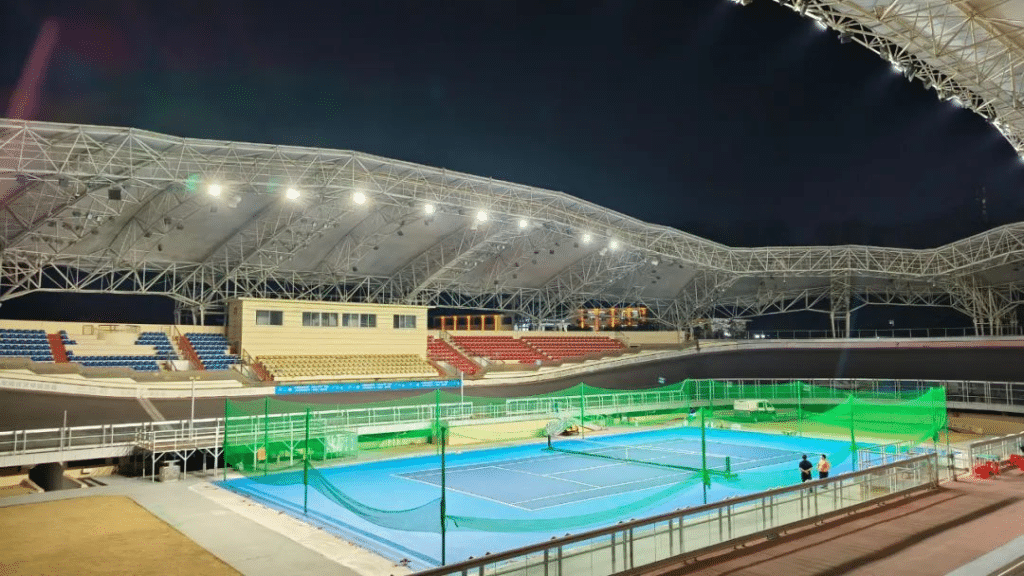
First, Track & Field High Mast Lighting: Clarify the Core Prerequisite: Track & Field Runway Classification (by Size + Usage)
First, distinguish the track type. Different track types have different core lighting requirements — professional competitions require seamless, high uniformity, while school/community venues balance energy efficiency and practicality. According to the relevant standards of the Chinese Athletics Association, they are mainly divided into the following three categories, which are also the core targets for our lighting design:
- Category I Venues (Professional Competition Grade): 400m standard track, curve radius 36.5m (preferred), at least 8 curve lanes and 8 straight lanes. Used for hosting various professional track and field competitions, requiring the highest lighting standards to meet the needs of HD broadcasting and precise officiating.
- Category II Venues (Training & Instruction Grade): 400m oval track, at least 6 curve lanes. Mostly used for daily training in schools and sports venues, also accommodating small-scale competitions. Lighting needs to ensure training clarity and visual comfort.
- Category III Venues (Recreation & Fitness Grade): Non-standard tracks (mainly 300m, 200m), at least 4 oval lanes. Commonly found in communities and small schools. The core requirements are basic illumination, energy efficiency, and durability, with no significant dark spots.
Here’s the Key Point: Detailed Lighting Layout + Illuminance Standards for Different Track Sizes
The core of lighting design is “achieving standard illuminance + uniformity without glare.” Illuminance (Lux) is a key indicator — it represents the amount of luminous flux received per unit area; the higher the value, the brighter the light. Uniformity determines whether there are differences in brightness across the venue, preventing visual discrepancies for athletes and officials. Below is a detailed breakdown of design points based on track size, which designers can directly reference.
I. 400m Standard Track (Category I/II Venues) — Professional-Grade Lighting Design
The 400m standard track is the most common type, divided into professional competition version (Category I) and training & instruction version (Category II). The main differences in lighting design between the two lie in illuminance and luminaire configuration, while the layout logic remains the same.
1. Lighting Layout Principles
Adopt a “four-corner high mast layout as the primary, supplemented by side lighting” approach to ensure full coverage and uniformity, preventing dark spots at the junctions of curves and straights.
- Pole Location: Positioned at the four corners of the track and field, 5-8m from the track edge to avoid obstructing views or athlete movement. If the venue is large (Category I), add 2-4 auxiliary high masts outside the straight lanes to supplement illuminance at the ends of the straights.
- Pole Height: A key parameter! For Category I venues (professional competitions), pole height should be 25-30m; for Category II venues (training & instruction), 20-25m, ensuring light evenly covers the entire track and reduces shadow overlap.
- Luminaire Angle: Projection angle of 15°-25°, with the projection angle to the track edge not exceeding 75°. Use cut-off type luminaires to prevent light from shining directly into athletes’ eyes and strictly control glare.
2. Illuminance Standards (Core, Must-Read)
Graded by usage scenario, aligning with the Chinese Athletics Association and lighting design standards, precisely matching different needs.
| Venue Type | Usage Scenario | Average Horizontal Illuminance (Lux) | Illuminance Uniformity | Glare Rating (GR) |
|---|---|---|---|---|
| Category I (400m Professional) | Professional Competition + HD Broadcast | ≥ 1500 | ≥ 0.7 | ≤ 50 |
| Category I (400m Professional) | Daily Training | 500 – 1000 | ≥ 0.6 | ≤ 55 |
| Category II (400m Instruction) | Training + Small Competitions | 300 – 500 | ≥ 0.5 | ≤ 55 |
3. Luminaire Selection Recommendations
Prioritize LED light sources, balancing energy efficiency and durability. Specific parameters should match venue needs:
- Power: Total power per pole for Category I venues is 800-1200W; for Category II venues, 600-800W. Use modular design to allow single-module replacement, reducing maintenance costs.
- Luminous Efficacy & Color Rendering: Luminous efficacy ≥ 150 lm/W, Color Rendering Index (Ra) ≥ 80 (Ra ≥ 90 for professional competitions), accurately reproducing track colors and athletes’ skin tones, suitable for HD broadcasting.
- Ingress Protection: ≥ IP67, providing waterproof, dustproof, and corrosion-resistant performance for outdoor conditions. Also equipped with intelligent temperature-controlled heat dissipation system to extend luminaire lifespan.
II. 300m Non-Standard Track (Category III Venue) — Practical-Grade Lighting Design
300m tracks are mostly used in schools and communities, with smaller curve radii (typically 25-30m) and lane widths around 1.22m. Lighting design focuses on “practicality, energy efficiency, and no dark spots,” without excessive pursuit of high illuminance.
1. Lighting Layout Principles
Adopt a “symmetrical layout on both sides,” eliminating the need for four-corner high masts, simplifying layout while reducing costs, suitable for small venue needs.
- Pole Location: Symmetrically arranged along the outer sides of the long edges of the track, with 3-4 poles per side, spaced 30-40m apart (pole spacing is 3-4 times the pole height), covering the entire track.
- Pole Height: 15-20m, no need for excessive height to avoid wasting light and reducing light pollution.
- Luminaire Angle: Projection angle of 20°-30°, focusing on covering the junctions of curves and straights to avoid shadow dead zones.
2. Illuminance Standards
No need to meet professional competition standards; should match daily usage scenarios:
- Daily Fitness, Recreational Activities: Average horizontal illuminance 100-200 Lux, uniformity ≥ 0.4.
- Basic School Training, Small Fun Competitions: Average horizontal illuminance 200-300 Lux, uniformity ≥ 0.5.
- Glare Rating (GR) ≤ 60, to avoid harsh glare and ensure sports safety.
3. Luminaire Selection Recommendations
Prioritize energy-efficient LED luminaires to control costs while meeting usage needs.
- Power: Total power per pole 300-500W, supporting time-based dimming, operating at low power for daily use to save energy.
- Luminous Efficacy & Color Rendering: Luminous efficacy ≥ 140 lm/W, Color Rendering Index (Ra) ≥ 75, sufficient for clearly identifying track markings.
- Ingress Protection: ≥ IP65, providing basic waterproof and dustproof performance for outdoor use, no need for high-end configurations.
III. 200m Non-Standard Track (Category III Venue) — Basic-Grade Lighting Design
200m tracks are mostly used in small schools and community fitness areas, with short circumference and narrow width (typically 4 lanes). Lighting design focuses on “basic illumination, simplicity, and durability,” without complex layouts.
1. Lighting Layout Principles
Adopt a “simple single-side or double-side layout,” flexibly adjusted according to venue size, focusing on covering the core areas of the track.
- Pole Location: 2-3 poles arranged on one side, or 2 poles symmetrically on both sides, positioned 3-5m from the track edge to avoid occupying venue space.
- Pole Height: 12-15m, suitable for small venues, ensuring light covers the entire track without significant dark spots.
- Luminaire Angle: Projection angle of 30°-40°, using wide-angle beam lenses (120°-150°) to expand the lighting range and reduce the number of luminaires.
2. Illuminance Standards
Meet basic usage needs, no need for high illuminance to avoid energy waste.
- Daily Fitness, Walking: Average horizontal illuminance 50-100 Lux, uniformity ≥ 0.3.
- Basic Training for Primary School Students: Average horizontal illuminance 100-150 Lux, uniformity ≥ 0.4.
- Glare Rating (GR) ≤ 65, to avoid affecting the sports safety of the elderly and children.
3. Luminaire Selection Recommendations
Choose economical and practical LED luminaires, prioritizing cost control and ease of maintenance.
- Power: Total power per pole 200-300W, compact and lightweight, easy to install and maintain.
- Luminous Efficacy & Color Rendering: Luminous efficacy ≥ 130 lm/W, Color Rendering Index (Ra) ≥ 70, sufficient for clearly identifying the track.
- Ingress Protection: ≥ IP65, providing basic waterproof performance for outdoor environments, prioritizing cost-effectiveness.
Must-Read for Designers: General Precautions (Pitfall Avoidance Guide)
Regardless of the track size, lighting design must follow the following 4 points to avoid pitfalls and ensure lighting effectiveness and usage safety:
- Glare Control is Key: Whether for professional or basic venues, avoid light shining directly into the eyes of athletes and officials. Prioritize cut-off type luminaires with a shielding angle ≥ 40°, paired with deep-baffle housings to reduce glare interference.
- Uniformity Prioritizes Over Illuminance: It is better to have slightly lower illuminance than to have differences in brightness. Use lighting simulation software like DIALux for 3D photometric modeling to optimize pole positions and luminaire angles.
- Combine Energy Efficiency with Intelligence: Prioritize LED light sources, supporting on-demand dimming and time-based control. Switch brightness according to usage scenarios (training, competitions, recreation) to reduce operating costs.
- Safety Protection is Essential: Install lightning protection devices at the top of poles, with grounding resistance less than 10Ω. Luminaires must have anti-fall and short-circuit prevention designs. Use stretch-resistant, aging-resistant flexible cables for cables to ensure outdoor safety.
Tip: Lighting design needs to be comprehensively adjusted based on the actual track dimensions, venue usage, and surrounding environment. The above are general standards. Customized solutions can be developed based on specific venue conditions (e.g., presence of stands, shading from surrounding buildings). As a designer, it is recommended to first model using lighting simulation software before finalizing the layout plan to ensure lighting effectiveness meets standards.
Kesimpulan
The core of track and field high mast lighting design is “adaptation” — adapting to the track size, usage scenario, and budget. For professional competition-grade 400m tracks, pursue high illuminance and high uniformity. For 300m and 200m tracks in schools and communities, balance practicality and energy efficiency.
By mastering the layout principles and illuminance standards above, whether designing a new venue or retrofitting an existing one, you can efficiently achieve results and avoid detours. If you need a customized lighting solution based on specific venue dimensions (such as custom curve radius, number of lanes), feel free to discuss.
Save this article, reference it directly for your next design, and easily handle track and field high mast lighting for different sizes!
✨ Professional track and field lighting design, ensuring every run is clear and bright ✨
Pertanyaan Umum tentang Cahaya Amasly
Q1.Dapatkah saya memesan sampel untuk lampu led?
A: Ya, kami menerima pesanan sampel untuk menguji dan memeriksa kualitas. Sampel campuran dapat diterima.
T2.Bagaimana dengan waktu tunggu?
A: Sampel membutuhkan 3-5 hari, waktu produksi massal membutuhkan 1-2 minggu.
Q3. Apakah Anda memiliki batas MOQ untuk pesanan lampu led?
A: MOQ rendah 1pc untuk pemeriksaan sampel tersedia.
Q4. Bagaimana Anda mengirimkan barang dan berapa lama waktu yang dibutuhkan untuk sampai?
A: Kami biasanya mengirim dengan DHL, UPS, FedEx atau TNT. Biasanya membutuhkan waktu 3-5 hari untuk tiba. Jalur udara dan pengiriman laut juga opsional.
Q5. Bagaimana cara melanjutkan pesanan untuk lampu led?
A:
Pertama, beri tahu kami kebutuhan atau aplikasi Anda.
Kedua, kami mengutip sesuai dengan kebutuhan Anda atau saran kami.
Ketiga, pelanggan mengonfirmasi sampel dan melakukan deposit untuk pesanan resmi.
Keempat, Kami mengatur produksi.
Q6. Apakah boleh mencetak saya LOGO pada produk lampu led?
A: Ya, mohon informasikan kepada kami secara resmi sebelum produksi kami dan konfirmasikan desainnya terlebih dahulu berdasarkan sampel kami.
T7: Apakah Anda menawarkan jaminan untuk produk?
A: Ya, kami menawarkan garansi 2-5 tahun untuk produk kami.
T8: Bagaimana cara menangani kerusakan?
A:
Pertama, produk kami menghasilkan sistem kontrol kualitas yang ketat dan tingkat kerusakan akan kurang dari 0,2%
Kedua, selama masa garansi, kami akan menyediakan suku cadang untuk mengganti suku cadang yang rusak ... Untuk pesanan dalam jumlah besar, kami akan menyediakan suku cadang yang rentan terlebih dahulu, atau kami dapat mendiskusikan solusi termasuk penarikan kembali berdasarkan situasi aktual.
T9: Dapatkah kita membuat lampu tahan ledakan tegangan rendah dengan tegangan AC/DC 12V, 24V, 36V, atau 48V?
Amasly dapat digunakan sebagai lampu tahan ledakan tegangan rendah dan tegangan tinggi - AC/DC 12V, 24V, 36V, 48V, AC 85-265V, AC 380V.
Q10: Dapatkah baterai darurat Lampu Ledakan Poof ditambahkan?
Lampu tahan ledakan Amasly dapat dilengkapi dengan baterai lithium darurat. Durasi darurat adalah 90 menit, 120 menit, atau 180 menit.
T11: Dapatkah lampu tahan ledakan Amasly disesuaikan sebagai produk OEM?
Lampu tahan ledakan Amasly dapat disesuaikan menurut kebutuhan pelanggan untuk lampu dan karton kemasan.
Produk Terkait
 ID
ID  EN
EN  ES
ES  AR
AR  DE
DE  FR
FR  RU
RU  IT
IT  PT
PT  ES_MX
ES_MX  RO
RO  EL
EL  TR
TR  KO
KO  HU_HU
HU_HU  JA
JA  NL
NL  BG
BG  CS
CS  DA
DA  SK
SK  UK
UK  TH
TH  VI
VI  MS
MS  TL
TL