
Amasly AMA-RD06 Adjustable LED Street Light | up to 180 lm/W
Konten
Kontak
- Email: sales01@amasly.com
- Ponsel: +86 13732643699
The Amasly AMA-RD06 is a die-cast aluminium LED street light for roads, residential streets, courtyards and squares. It comes in four builds, 50W, 100W, 150W and 200W, all rated 170–180 lm/W on a 90–305V input.
Two details separate it from a standard road luminaire. The head sits on a 90° rotating die-cast bracket with an inclinometer built into the housing, and the driver has its own power box that opens with a buckle instead of a screwdriver. Both matter to the crew on the pole, not only to the spec sheet.
The rest of the build is what a road lighting specifier expects: ADC12 body, 3030 LED chips on a thermally conductive aluminium PCB, tempered glass over a UV-stabilised PC lens, a 10 kV or 20 kV surge module, IK09 impact rating, and CE and RoHS certification.
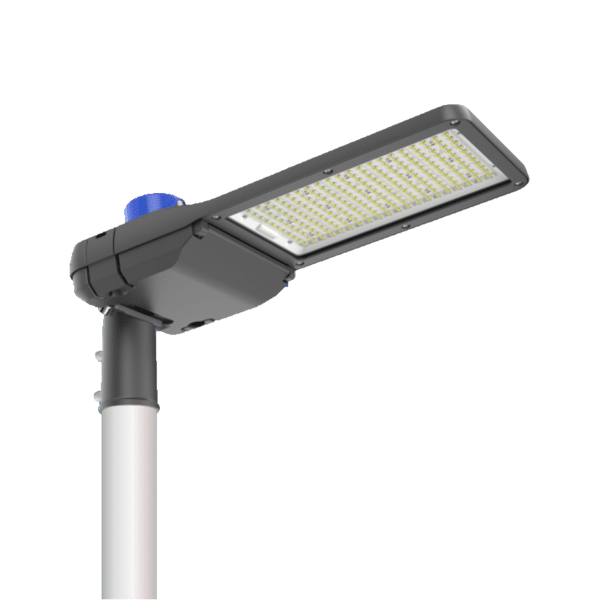
AMA-RD06 with the 90° die-cast bracket and the rear photocell position
Up to 180 lm/W: the same road on fewer watts
Up to 180 lm/W. A 100 W AMA-RD06 puts out roughly 18,000 lm, which is the output a 150 W luminaire reaches at 120 lm/W.
Efficacy decides most of the running cost. At 180 lm/W, nearly all of the input watt goes out as light; at 120 lm/W a third of it goes into heat instead. On a road that needs about 18,000 lm, that is the difference between hanging a 100 W fitting and a 150 W one on the same pole.
The saving lands in three places. The feeder carries a smaller load, the energy line on the bill comes down by the same ratio, and there is less heat to move out of the housing. The last one is the part that ages a driver, so it buys service life as well as kilowatt hours.
Efficacy is quoted at 170–180 lm/W across the four builds. The range holds at every wattage because the optical stack and the thermal path stay the same from 50 W to 200 W.
What the bracket changes on site
A street light is more often let down by its mounting than by its LED. Wrong tilt, an adaptor kit that arrived late, or an angle that puts light into bedroom windows three streets over.
The 90° rotating die-cast aluminium holder covers horizontal mounting on a straight pole, vertical mounting at the top of a pole, and wall mounting off a building face. One bracket replaces the separate adaptor kits that distributors usually carry, which shortens the SKU list and the odds of shipping the wrong one to site.
The inclinometer is read directly while the crew adjusts the angle. On wall brackets this is where the job is won or lost: a few degrees decide whether the light lands on the footpath or washes up the facade. The holder takes a Ø60 mm spigot, the size most existing poles and outreach arms already use.
Fitur
Tool-free power box, with a knife switch
The rear power compartment opens with a buckle. No screwdriver, no screws dropped in the mud at 2 a.m. Inside, the driver, terminals and surge module sit in a cool zone, separated from the LED board and heat sink in the hot zone.
A knife switch cuts the driver circuit as soon as the cover opens, so the light goes out before hands enter the box. For a maintenance team working at height, that removes a step that is easy to skip.
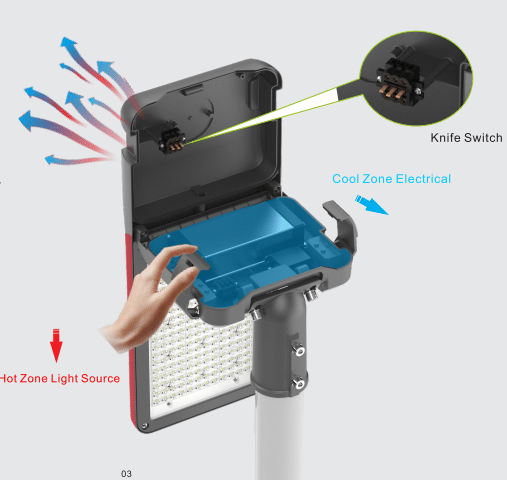
Power box open: driver, terminals and surge module in the cool zone
Heat path checked in simulation
The housing is ADC12 die-cast aluminium, chosen for thermal conductivity rather than looks. The LED board is a highly thermally conductive aluminium PCB clamped to the body, so heat leaves the chips and enters the casting instead of sitting in the board.
The engineering team ran finite element analysis on the whole housing: conduction through the casting, air convection along the fins, and radiation from the surface. At 150W the temperature curve flattens within the first hour of switch-on and stays there. That is the behaviour that matters on a summer afternoon with the sun on the same face.
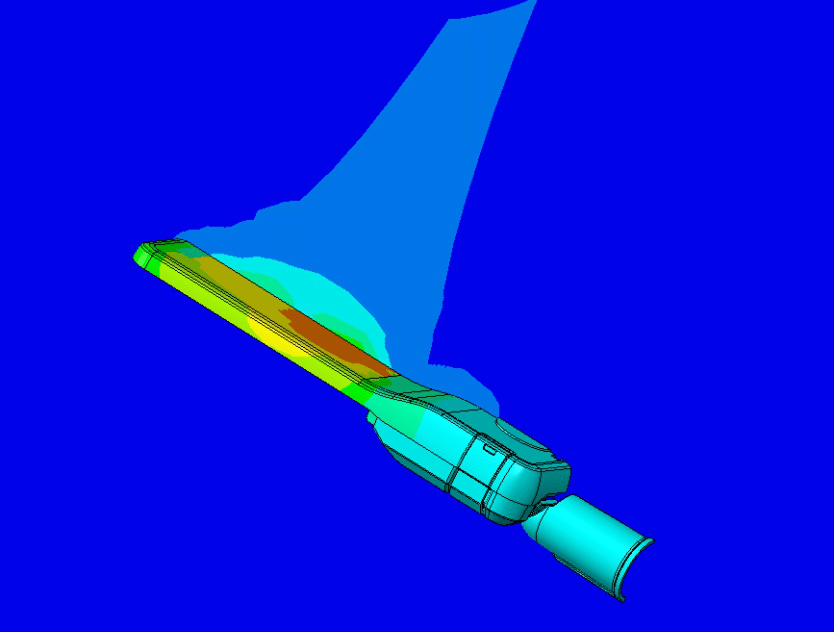
Thermal simulation: conduction through the ADC12 body and convection along the fins
Optics: Type II and Type III
Two distributions ship as standard. Type II keeps a narrower pattern for footpaths, cycle tracks and residential streets with close pole spacing. Type III spreads wider for carriageways, parking rows and squares.
The optical stack is a nano-PC reflector, a UV-stabilised PC lens and tempered glass. Each layer does a different job: the reflector shapes the beam, the lens protects the LEDs and evens out the output, the glass takes the impact and the cleaning.
Both distributions are cut-off designs, so light stays on the road surface instead of spilling onto walls and windows. Send road width, mounting height and the scene, and the team will run a DIALux simulation and return a layout with pole spacing.
Surge, impact and weather
Every model carries a surge protection module rated 10 kV or 20 kV, depending on the build ordered. Rural feeders and coastal sites with heavy switching on the line are where this earns back its cost.
Impact rating is IK09 and the front cover is tempered glass rather than acrylic. A breather valve equalises pressure inside the housing as temperature swings, which stops moist air being pulled in through the glands. Cable entry uses a waterproof gland, and the light source is sealed with UV-resistant silicone gel.
The working range is −40 °C to +45 °C, wide enough for northern winters and unshaded desert installations.
Finish and wind load
The casting is finished in Akzo powder coating. It resists chalking, peeling at the edges is rare, and salt air and roadside grit do not take it off in the first season.
The profile is streamlined and the photocell sits at the rear rather than on top of the housing. Lower wind load means less stress on the bracket, and on exposed sites it can pull the pole specification down a size.
Installation and angle adjustment
Horizontal, vertical and wall-mounted arrangements all run off the same bracket, with angle adjustment across 90°. The four installation photographs below show the typical setups: outreach arm, top of pole, wall bracket, and the tilt range.
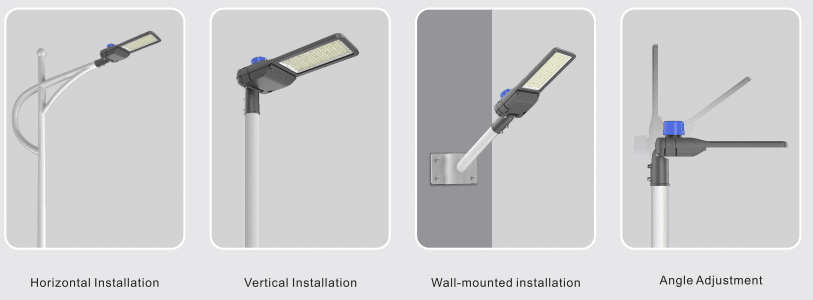
Mounting options: horizontal, vertical, wall bracket and angle adjustment
Spesifikasi
| Parameter | 50 W | 100 W | 150 W | 200 W |
| Input voltage | 90–305 V AC | 90–305 V AC | 90–305 V AC | 90–305 V AC |
| Power factor | >0.95 | >0.95 | >0.95 | >0.95 |
| Surge protection | 10 kV / 20 kV | 10 kV / 20 kV | 10 kV / 20 kV | 10 kV / 20 kV |
| Efficacy | 170–180 lm/W | 170–180 lm/W | 170–180 lm/W | 170–180 lm/W |
| Colour temperature | 3000–6500 K | 3000–6500 K | 3000–6500 K | 3000–6500 K |
| LED type and count | 3030, 96 pcs | 3030, 144 pcs | 3030, 240 pcs | 3030, 320 pcs |
| CRI | >70 | >70 | >70 | >70 |
| Beam angle | Type II / Type III | Type II / Type III | Type II / Type III | Type II / Type III |
| Impact protection | IK09 | IK09 | IK09 | IK09 |
| Ambient temperature | −40 °C to +45 °C | −40 °C to +45 °C | −40 °C to +45 °C | −40 °C to +45 °C |
| Luminaire size (L×W×H) | 410×180×96 mm | 520×180×96 mm | 620×215×96 mm | 620×265×96 mm |
| Sertifikasi | CE, RoHS | CE, RoHS | CE, RoHS | CE, RoHS |
The LED count changes with the wattage: 96 chips at 50W, 144 at 100W, 240 at 150W and 320 at 200W, all in 3030 packages.
Dimensions, packing and container loading
| Model | Daya | Luminaire (mm) | Carton (cm) | Pcs/ctn | 20′ GP | 40′ GP | 40′ HQ |
| AMA-RD06-50W | 50 W | 410×180×96 | 51×21×13 | 1 | 2,011 | 4,166 | 4,884 |
| AMA-RD06-100W | 100 W | 520×180×96 | 61×21×13 | 1 | 1,681 | 3,483 | 4,083 |
| AMA-RD06-150W | 150 W | 620×215×96 | 71×25×13 | 1 | 1,213 | 2,514 | 2,947 |
| AMA-RD06-200W | 200 W | 620×265×96 | 71×30×13 | 1 | 1,011 | 2,095 | 2,456 |
Each luminaire ships one per carton, packed in EVA foam at both ends of the housing. A 40HQ container holds 4,884 pieces of the 50W build and 2,456 pieces of the 200W build.
Choosing the wattage
| Model | Mounting height | Typical application |
| 50 W | 2–4 m | Footpaths, courtyards, parking bays, park lighting |
| 100 W | 4–6 m | Residential streets, estate roads, community roads |
| 150 W | 7–8 m | Collector roads, industrial access roads |
| 200 W | 9–10 m | Main roads and trunk roads |
These heights are the factory recommendation. Pole spacing is a separate calculation: it depends on the illuminance class in the standard your project is designed to, not on the wattage alone. A 200W luminaire spaced badly will read darker on the road than a 100W unit spaced well.
Where the AMA-RD06 is used
Municipal and residential roads are the main line of work: carriageways, estate roads and the access roads around industrial sites. The smaller jobs usually ship with the same order: courtyard lighting, park paths, village squares, car parks and community streets on rural road programmes.
Wall mounting makes it useful where there is no pole to raise, and the photocell option lets a site run dusk-to-dawn switching without a control cabinet or a timer.
What you can specify
- Wattage: 50W, 100W, 150W or 200W
- Colour temperature: 3000 K to 6500 K
- Distribution: Type II or Type III
- Surge module: 10 kV or 20 kV
- Photocell: light sensor for dusk-to-dawn switching
- Housing colour: standard grey; [other RAL colours on request]
- Branding: Amasly label and laser marking, or your own brand on OEM orders
- Documentation: DIALux layout, CE and RoHS declarations, [test reports on request]
- Commercial: [MOQ], [lead time], [price], [warranty]
Pertanyaan yang Sering Diajukan
What is the difference between Type II and Type III optics?
Type II concentrates light along the road axis with a narrower spread, which suits footpaths and residential streets with close poles. Type III widens the pattern across the carriageway, so it covers more lanes from the same mounting height. Choose by road width and pole spacing, not by wattage.
Can the AMA-RD06 replace an existing high-pressure sodium fixture?
Usually yes, if the pole has a Ø60 mm spigot. The bracket covers horizontal and vertical mounting, so most existing arms can be reused. Check the safe working load on the pole before you add weight or move up a wattage.
Does it come with a photocell?
A light sensor can be fitted for dusk-to-dawn operation. The housing has a dedicated rear position for it, so the sensor does not sit in the beam or cast a shadow on the lens. [Confirm the option code with the factory before you order.]
What input voltage does the driver accept?
90–305 V AC, with a power factor above 0.95. That covers 120V and 230V markets on one SKU, and it rides out the voltage sag that shows up on rural feeders.
How do I know which wattage to order?
Start with mounting height and road class: 50W for 2–4 m, 100W for 4–6 m, 150W for 7–8 m, 200W for 9–10 m. Confirm with a DIALux run, because the required lux comes from the road class in your local standard.
What certifications are included?
CE and RoHS as standard. [Add the approvals your market requires, such as local grid-connection approval or energy label registration, before you publish a list.]
Ask for a layout and a price
Send four things and you get a DIALux layout plus a quotation: road width and length, mounting height, the road class or target illuminance, and the ambient temperature range on site. A pole schedule works too, if one already exists.Email: [sales@amasly.com] WhatsApp: [+86 13732643699]
Pertanyaan Umum tentang Cahaya Amasly
Q1.Dapatkah saya memesan sampel untuk lampu led?
A: Ya, kami menerima pesanan sampel untuk menguji dan memeriksa kualitas. Sampel campuran dapat diterima.
T2.Bagaimana dengan waktu tunggu?
A: Sampel membutuhkan 3-5 hari, waktu produksi massal membutuhkan 1-2 minggu.
Q3. Apakah Anda memiliki batas MOQ untuk pesanan lampu led?
A: MOQ rendah 1pc untuk pemeriksaan sampel tersedia.
Q4. Bagaimana Anda mengirimkan barang dan berapa lama waktu yang dibutuhkan untuk sampai?
A: Kami biasanya mengirim dengan DHL, UPS, FedEx atau TNT. Biasanya membutuhkan waktu 3-5 hari untuk tiba. Jalur udara dan pengiriman laut juga opsional.
Q5. Bagaimana cara melanjutkan pesanan untuk lampu led?
A:
Pertama, beri tahu kami kebutuhan atau aplikasi Anda.
Kedua, kami mengutip sesuai dengan kebutuhan Anda atau saran kami.
Ketiga, pelanggan mengonfirmasi sampel dan melakukan deposit untuk pesanan resmi.
Keempat, Kami mengatur produksi.
Q6. Apakah boleh mencetak saya LOGO pada produk lampu led?
A: Ya, mohon informasikan kepada kami secara resmi sebelum produksi kami dan konfirmasikan desainnya terlebih dahulu berdasarkan sampel kami.
T7: Apakah Anda menawarkan jaminan untuk produk?
A: Ya, kami menawarkan garansi 2-5 tahun untuk produk kami.
T8: Bagaimana cara menangani kerusakan?
A:
Pertama, produk kami menghasilkan sistem kontrol kualitas yang ketat dan tingkat kerusakan akan kurang dari 0,2%
Kedua, selama masa garansi, kami akan menyediakan suku cadang untuk mengganti suku cadang yang rusak ... Untuk pesanan dalam jumlah besar, kami akan menyediakan suku cadang yang rentan terlebih dahulu, atau kami dapat mendiskusikan solusi termasuk penarikan kembali berdasarkan situasi aktual.
T9: Dapatkah kita membuat lampu tahan ledakan tegangan rendah dengan tegangan AC/DC 12V, 24V, 36V, atau 48V?
Amasly dapat digunakan sebagai lampu tahan ledakan tegangan rendah dan tegangan tinggi - AC/DC 12V, 24V, 36V, 48V, AC 85-265V, AC 380V.
Q10: Dapatkah baterai darurat Lampu Ledakan Poof ditambahkan?
Lampu tahan ledakan Amasly dapat dilengkapi dengan baterai lithium darurat. Durasi darurat adalah 90 menit, 120 menit, atau 180 menit.
T11: Dapatkah lampu tahan ledakan Amasly disesuaikan sebagai produk OEM?
Lampu tahan ledakan Amasly dapat disesuaikan menurut kebutuhan pelanggan untuk lampu dan karton kemasan.
Produk Terkait
 Indonesian
 English
 Spanish
 Arabic
 German
 French
 Russian
 Thai
 Vietnamese
 Malay
 Italian
 Portuguese
 Romanian
 Greek
 Turkish
 Korean
 Japanese
 Dutch