
Basketball Court Lighting Design and Technical Analysis
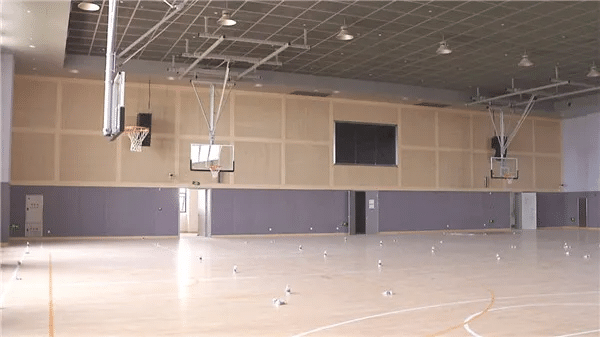
Basketball Court Lighting Introduce:
This article introduces lighting standards and key parameters: using tables to introduce the illuminance, uniformity and color rendering requirements for different levels of play, and analyze the glare control index.
Core product technology analysis: list the mainstream LED lamps and lanterns technical parameters, analyze the micro-reflector and skimming uniform light and other optical innovation technology.
Design methodology and practice: Compare and contrast the full sky star and the two sides of the lighting scheme through the case of East China Basketball Stadium, and illustrate the simulation process of DIALux.
Cost and energy saving analysis: Compare the annual energy consumption data of LED and traditional light source, and cite the economic benefit cases in specific provinces and cities.
Implementation process and innovation trends: step-by-step description of the lighting design process, introduction of HDTV lighting, polarization control and other cutting-edge technologies.
Basketball Court Lighting standards and key performance parameters
Basketball court lighting design needs to follow strict international standards, which are subdivided into multiple lighting levels according to the level of competition and usage requirements. Modern basketball court lighting has changed from simply pursuing “bright enough” to a comprehensive control of optical quality, and its core indicators include illuminance level, uniformity, glare control and color rendering performance and other dimensions.
Graded illumination standard system
Training and amateur competitions: basic training and non-competitive activities require a level of illumination of not less than 150-300 lux (lx), domestic competitions need to reach 600 lux. At this time mainly to meet the basic visual needs of athletes.
Professional events and television broadcasts: domestic television broadcast events require horizontal illumination 750 lux while vertical illumination 500 lux; international tournament standards to 1000/750 lux; and high-definition television broadcasts (HDTV) events require up to 2,000 lux horizontal illumination and 1,500 lux vertical illumination, to ensure that high-speed cameras to capture the picture without shading.
Multi-level control mode: modern basketball halls are commonly set up three lighting control modes: amateur game mode (500lx), entertainment mode (300lx) and cleaning mode (150lx), through the split control to achieve energy saving.
Table: Basketball court grading illuminance standard reference value
| Competition Grade | Usage Scene | Horizontal illuminance (lx) | Vertical illuminance (lx) | Uniformity U1 | Color rendering index Ra |
| Amateur grade | Training activities | 150 | – | ≥0.4 | ≥65 |
| Amateur level | Domestic competition | 600 | – | ≥0.5 | ≥65 |
| Professional level | Television broadcast (domestic) | 750 | 500 | ≥0.5 | ≥65 |
| Professional grade | Television broadcast (international) | 1000 | 750 | ≥0.6 | ≥80 |
| Professional | HDTV broadcast | 2000 | 1500 | ≥0.7 | ≥80 |

Basketball Court Lighting Optical quality key indicators
Uniformity of illumination: the core indicator for measuring the difference between light and darkness of the court, calculated as minimum illumination/average illumination (U1) or minimum illumination/maximum illumination (U2). The International Basketball Federation (FIBA) stipulates that U1 ≥ 0.7 in order to avoid visual adaptation hysteresis, and high-level tournaments require more than 0.8. Innovative lighting solutions have achieved 92.17% ultra-high uniformity (equivalent to U0=0.92).
Glare control: The frequent upward movement of basketball makes glare control especially critical. The use of honeycomb convex micro-reflector technology lamps and lanterns can reduce axial glare by more than 90%, outdoor venues need to be ≤ 50 glare value, while the advanced design can be controlled within 29.
Spectral quality: LED light source color temperature is generally used 4000K neutral white, color rendering index (Ra) ≥ 80 (OB needs to be ≥ 90), to ensure that the color of the jersey true reproduction. Power factor needs to be ≥ 0.98 to reduce grid harmonic pollution.
Basketball Court Lighting Core product technology and optical innovation
Basketball lighting technology has been fully transformed from traditional metal halide lamps to high-precision LEDs, and this change not only brings energy efficiency, but also gives rise to revolutionary optical design.
Mainstream LED lamps and lanterns technical parameters
Power coverage: modern sports LED lamps and lanterns form a perfect power sequence, from 100W embedded auxiliary lamps to 1800W main game lights. Typical example is the MT-GD150B (150W), with a luminous flux of 24,750 lumens and a luminous efficacy of 165lm/W, far exceeding the 80lm/W of metal halide lamps.
Thermal management breakthrough: 2.0mm aluminum substrate (thermal conductivity of 3.0) with node temperature rise <60 ℃ design, to ensure 50,000-80,000 hours of service life, compared with the traditional light source 5-8 times longer.
Protection performance: IP65 protection level ensures dustproof and waterproof, adapting to diverse indoor and outdoor environments. Shockproof performance to meet the challenge of mechanical stress such as basketball impact.
Table: Mainstream basketball court lighting performance comparison
| Product Type | Power | Luminous Flux | Luminous Efficiency | Glare Control | Applicable Scene |
| Amasly Stadium Light | 150 W | 24750lm | 165lm/W | Honeycomb Micro Reflector | Professional Indoor Pavilion |
| Amasly Stadium Light | 300W | 45000lm | 150lm/W | Polarization controlled light 73° | Outdoor Stadium |
| Amasly Stadium Light | 240W | 36000lm | 150lm/W | Asymmetric light distribution | Community Pitch |
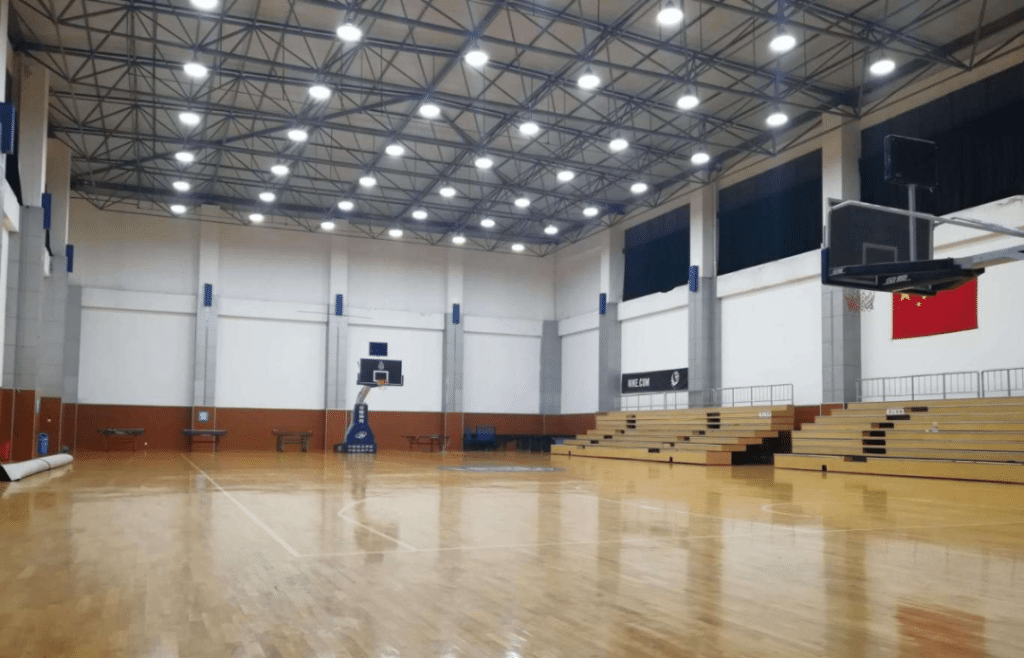
Basketball Court Lighting Optical system innovative design
Micro-reflector technology: Yueton HGU series adopts vacuum coated reflective layer and resin protective film composite structure. The honeycomb convex micro-reflector enables the light to be accurately projected to the working surface after only one reflection, which improves the light efficiency by 40% and reduces the axial glare by 90%. The dielectric layer realizes a smooth transition between the expansion coefficient of the substrate and the metal layer, avoiding high-temperature film removal.
Skimming technology: The new composite concentrator (CPC reflector + tubular reflector) skims the LED light out of the light panel. Maximum uniformity (92.17%) is achieved by TracePro simulation with a 0˚ grazing angle, and the light-guide-less design reduces coupling loss, which is especially suitable for low brightness and high uniformity scenarios.
Polarization control technology: MECREE P73 series controls polarized light at a 73˚ angle to achieve a 0% upward light ratio, effectively limiting light spill. After applying this technology to outdoor basketball courts, the light utilization rate is increased from 52% to 75%, and the glare value is reduced to 29 (standard requirement ≤50).
Basketball Court Lighting Design methodology and practice case analysis
Basketball lighting design needs to integrate optical performance and architectural space characteristics, through scientific lighting to achieve visual comfort and energy saving goals.
Space-adapted lighting program
Star arrangement: applicable to venues with a floor height of less than 12m (e.g. community gymnasium). The lamps are symmetrically arranged on the ceiling, and the light beam is vertically downward. Advantage is excellent uniformity of horizontal illumination (U1≥0.65), while the disadvantage is insufficient vertical illumination and obvious shadow. A museum in East China (42×32×12.5m) uses 25 400W metal halide lamps to achieve an average illuminance of 524lx, with a uniformity of 0.62.
Two-side arrangement: the lamps are installed on both sides of the venue along the roadway, and the aiming angle is ≤65°. Suitable for 13-20m high-rise hall, especially to meet the vertical illumination needs of the TV broadcast. Comparison of the same case shows that 24 lamps that reach similar illumination, annual power savings of 1000kWh, and easy to maintain.
Hybrid arrangement: Combining ceiling and lateral lighting to balance the horizontal/vertical illuminance ratio. Asymmetric light distribution luminaires are required for multi-functional gymnasiums, with optimized light distribution curves superimposed by DIALux.
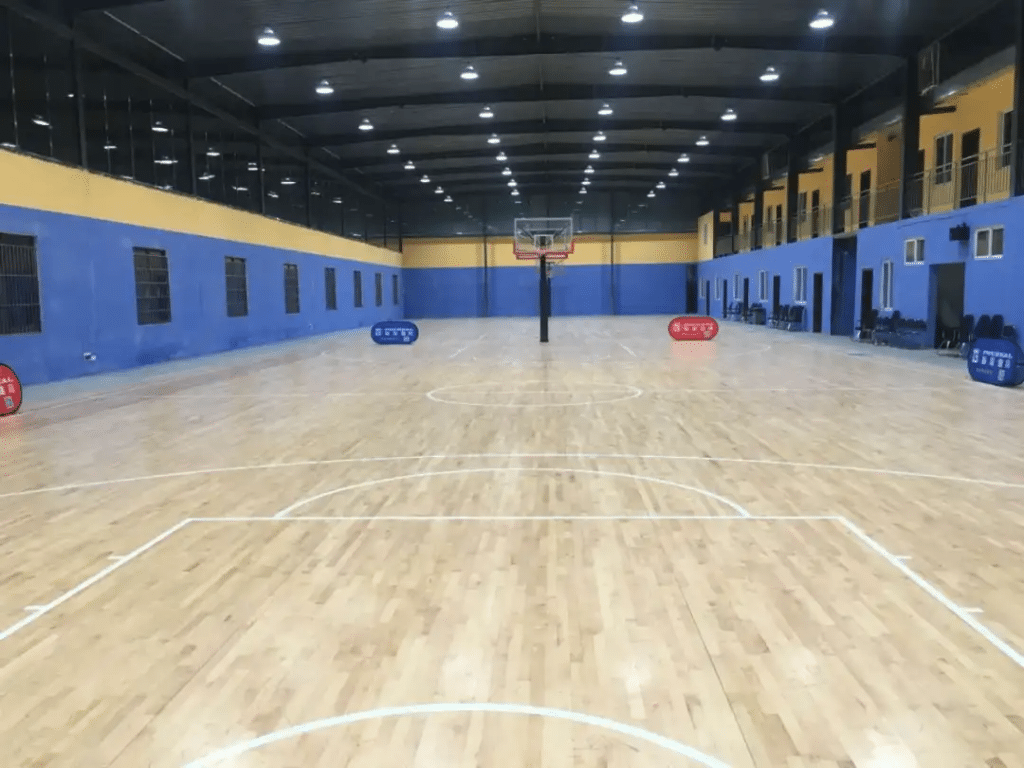
Basketball Court Lighting East China Basketball Stadium LED Retrofit Case
Project background: A Class II basketball hall in East China (42m×32m×12.5m), originally with 400W metal halide lamps, annual operation of 2500 hours, illuminance standard 500lx.
Program comparison:
Metal halide lamp program: 25 400W lamps and lanterns (total power 10kW), luminous efficacy 115lm/W, average illuminance 524lx, uniformity 0.62
LED program: 30 220W lamps and lanterns (total power 6.6kW), luminous efficacy 145lm/W, average illuminance 513lx, evenness 0.65
Energy saving benefit: annual power saving 9,860kWh (equivalent to 3,400W power difference), according to the calculation of 1 yuan/kWh, the annual saving of electricity 9,860 yuan. 3 years of LED warranty is better than metal halide lamps for 1 year, reducing the maintenance frequency by 60%.
DIALux simulation driver design
Professional lighting design needs to be pre-verified with the help of light environment simulation software:
1. Model construction: import the 3D model of the venue (with reflectance parameters)
2. Luminaire selection: Load the IES light distribution curve file (e.g. asymmetric light distribution).
3. Optimization: Adjust the installation height and pitch angle to control the glare.
4. Result analysis: output equal illuminance curve, 3D rendering animation.
A project through simulation found: 12m pole height using 8 ° tilt angle installation, uniformity increased by 18%, glare value reduced by 35%.
Cost Analysis and Energy Efficiency
The economy of lighting system needs to synthesize the initial investment and long-term operating costs, and LED’s high efficiency characteristics make it show significant advantages in the whole life cycle.
Initial investment comparison
Professional basketball lighting system initial investment includes:
Lamps and lanterns cost: LED unit price is higher (about metal halide lamps 2 times), but the number of 30% less
Electrical package: LED power density 5.5W/m², lower than metal halide lamps 8.33W/m².
Cable specification
Structural costs: 40% less weight for LEDs, reducing the structural load on the ceiling.
Although the initial investment in LEDs is about 20-30% higher, government energy saving subsidies can offset some of the difference.
Full cycle energy saving benefits
Take a standard outdoor court (6 poles) installing 35 300W LEDs as an example:
Comparison of energy consumption: LED total power 11.2kW, the same illumination needs 970W metal halide lamp (total power 34kW)
Annual electricity cost calculation (5 hours / day, 1 yuan / kWh):
LED annual power consumption: 35 × 0.323kWh × 5h × 365 = 20,631 yuan
Metal halide lamp annual power consumption: 35 × 0.97kWh × 5h × 365 = 61,958 yuan
Annual net savings: 41,327 yuan (about 6,261 U.S. dollars), two-year cumulative total of more than 82,000 yuan
Provincial and municipal differentiated benefits: Guangdong and other high electricity price provinces (1.2 RMB/kWh) annual savings of up to 49,592 RMB; Heilongjiang low usage rate venues (1,500 hours/year) can still save 24,796 RMB.
Professional Implementation Process and Innovation Trends
Basketball lighting modernization needs to follow a systematic process, and forward-looking integration of innovative technologies to meet future development needs.
Professional design and implementation process
1. Demand analysis: Define the level of the game (HDTV broadcast or not), the mode of operation (average daily hours of light)
2. Site survey: Measurement of space dimensions (ceiling height, roof structure), existing line conditions.
3. Program simulation: DIALux simulates the lighting scheme and outputs a forecast report on illuminance/uniformity/glare value.
4. Product selection: Selection of anti-glare luminaires with suitable light distribution curves (wide beam/narrow beam).
5. Installation and commissioning: Strictly control the aiming angle (25°-65°), use the illuminance meter on-site calibration.
6. Mode Programming: Setting the lighting mode for competition/training/cleaning.
Cutting-edge innovations
HDTV broadcast optimization: Ra>90, TLCI (Television Lighting Consistency Index) ≥85, elimination of stroboscopic flicker (fluctuation depth <1%) under 2000lx high illumination.
Intelligent control system: automatic dimming based on the course of the game, energy-saving auditorium zoned lighting. Combined with radar sensing, it realizes the energy-saving mode of “dimming lights when people leave”.
Polarized light technology: 0% upward light rate, precise control of beam boundaries, 30% reduction of overspill light pollution.
Digital Twin Operation and Maintenance: BIM modeling integrates lamp life prediction, automatically prompts replacement nodes, and reduces maintenance costs.
Industry Alert: A CBA arena had excessive glare value (GR>55) leading to complaints from players, and after the transformation using honeycomb micro-reflector technology, the glare value was reduced to 29, and the visual recovery time was shortened to within 0.5 seconds.
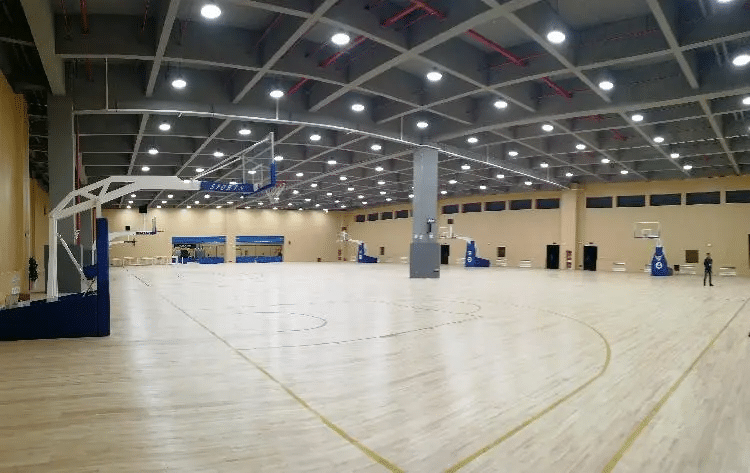
Conclusion and Design Recommendations
Basketball gymnasium lighting has evolved from basic lighting to a comprehensive system integrating visual physiology, optical engineering and energy-saving technology. Through case validation and data analysis, key design guidelines can be summarized:
Product selection: Priority is given to LED luminaires with luminous efficacy >150lm/W and UGR<19, and professional venues recommend MT-GD series or MECREE P73 polarized series.
Lighting strategy: low space (<12m) adopts full star arrangement, high space (>13m) prefers two-side arrangement, aiming angle is strictly controlled at 25°-65°.
Energy-saving path: Setting multi-level lighting modes, combined with LED intelligent control, typical venues can save up to 40,000kWh or more per year.
Innovative integration: reserved HDTV broadcast interface, integrated polarization light control technology to cope with future 8K broadcast demand.
The ultimate goal of basketball lighting design is to create an immersive viewing experience for spectators under the condition of safeguarding the visual safety of athletes, and at the same time reduce the carbon footprint of the arena through refined energy management. With the implementation of the new FIBA lighting regulations in 2023, high uniformity (U1 ≥ 0.8), low glare (GR < 30) has become a mandatory indicator for the certification of professional venues, the lighting system as the “invisible infrastructure” of the basketball stadium, and its technological innovation will continue to promote the upgrading of the tournament experience.
Standard: IEC
Related Products
 English
  Spanish (Spain)
  Arabic
  German
  French
  Russian
  Italian
  Portuguese
  Spanish (Mexico)
  Romanian
  Greek
Greek  Turkish
  Korean
  Hungarian
  Japanese
  Dutch
Dutch  Bulgarian
  Czech
Czech  Danish
  Slovak
  Ukrainian
  Thai
Thai  Vietnamese
  Indonesian
  Malay
Malay  Tagalog