
Tennis court lighting solutions: finding the right lighting for your tennis court
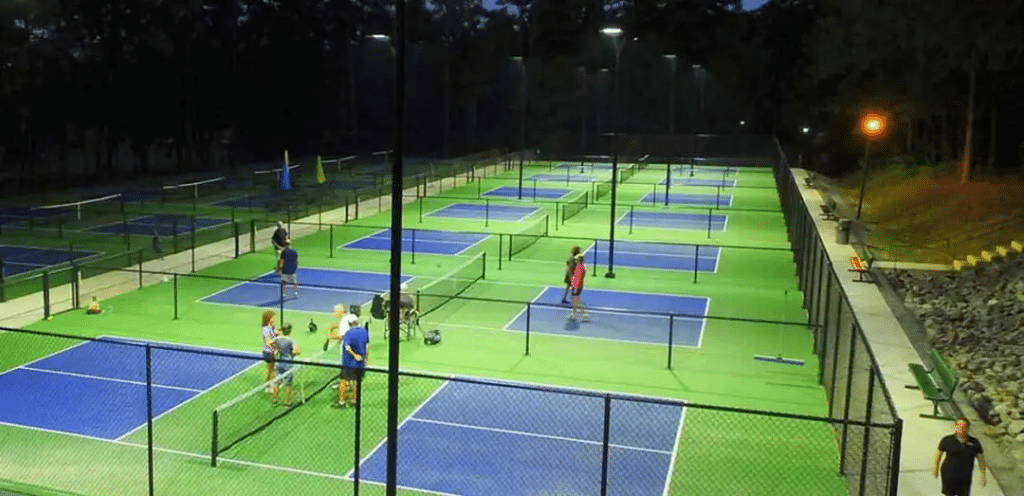
Reasons for Tennis Court Lighting Solutions
In tennis, some professional players can serve at speeds of over 200 kilometers per hour. Due to the excessive speed of tennis balls, it is difficult to judge the effectiveness of their strokes. This also greatly increases the difficulty of the tennis game, and the (illuminance value and glare value) requirements for tennis lighting are more stringent and professional.
For non-competitive tennis courts, people also want to be able to enjoy the sport comfortably after a long day’s work, so we need to provide adequate lighting for the courts at night. This not only improves the safety of the sport, but also creates a pleasant mood for the athletes.
So how do you provide the right lighting for a tennis court? This requires the right lighting accessories to provide a bright and comfortable lighting environment for sports facilities. What do you want to achieve and what information do you need to know before starting a project? Does this confuse you? Follow the steps below and perhaps you’ll have a clearer idea of how to get started.
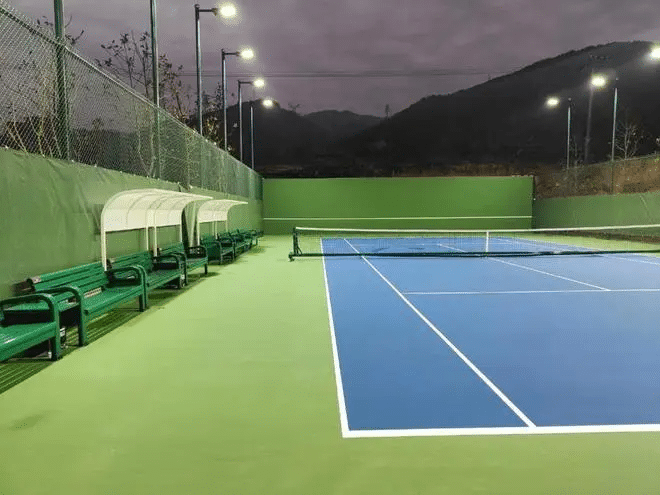
Tennis Court Lighting Standards
Tennis court lighting standards need to meet the visual needs of the athletes, the requirements of the TV broadcast and the spectator experience, as well as comply with the relevant regulations of international sports organizations (e.g. ITF, ATP, WTA, etc.). The following are common points of tennis court lighting standards:
Lighting Levels (Illumination Requirements)
Depending on the level of play and use, tennis court illumination requirements vary (unit: lux/lux): amateur training/recreation: 200-300 lux; amateur tournaments/club matches: 300-500 lux; professional tournaments (e.g. ATP/WTA Tour): 500 -International tournaments/television broadcasts: 750-1500 lux (higher uniformity for HD broadcasts).
International Tennis Federation (ITF) recommendations: Horizontal illumination of the playing area (baseline to baseline) ≥ 500 lux (professional tournaments). Illumination of the spectator stands ≥ 100 lux.
Uniformity (Uo and Ug)
Uo (uniformity of playing area): min illumination/max illumination ≥ 0.7 (≥ 0.8 for professional matches). ug (global uniformity): min illumination/average illumination ≥ 0.6. Avoid glare or shadowed areas that may affect players’ judgment.
Glare Control
Luminaires should be installed at a sufficient height (usually ≥ 8 meters) to avoid direct glare on athletes or spectators. Use anti-glare luminaires or grilles to ensure a soft distribution of light.
Light Source and Color Temperature
Light source type: LED (mainstream choice, energy-saving and long life), metal halide lamps (traditional choice); color temperature: 4000K-5000K (neutral white to cool white, to ensure the color is true); color rendering index (CRI): ≥ 80 (≥ 90 recommended for professional competitions).
Lamp Layout
Lateral arrangement: the lamps are installed on both sides of the court, with a height of ≥8 meters and at an angle with the sideline; four-corner arrangement: applicable to small venues, shadows need to be controlled. Avoid direct light to the players’ eyes or interference with the judgment of ball trajectory.
Other requirements
Lighting control system: can be adjusted in different modes (e.g. training mode, match mode, broadcast mode); maintenance: regular cleaning of lamps to avoid light decay affecting illumination; energy saving: give priority to high-efficiency LED lamps, in line with environmental standards.
Reference Standards
International standards: ITF Guide to Tennis Facilities, CIE 83-1989 (Sports Lighting); National standards: e.g. China’s JGJ 153-2016 Standard for Lighting Design and Testing of Stadiums.
Example (professional competition venues): illuminance: 750 lux for the main match area, 500 lux for the warm-up area; uniformity: Uo ≥ 0.8, Ug ≥ 0.6; fixture height: 12-15 meters (adjusted according to the court size).
What factors should be considered for tennis court lighting?
Tennis Court Size
In most cases, singles tennis courts are 78 feet long and 27 feet wide, and doubles courts are 36 feet wide. It is also important to know the size of the additional extension area of the tennis court.
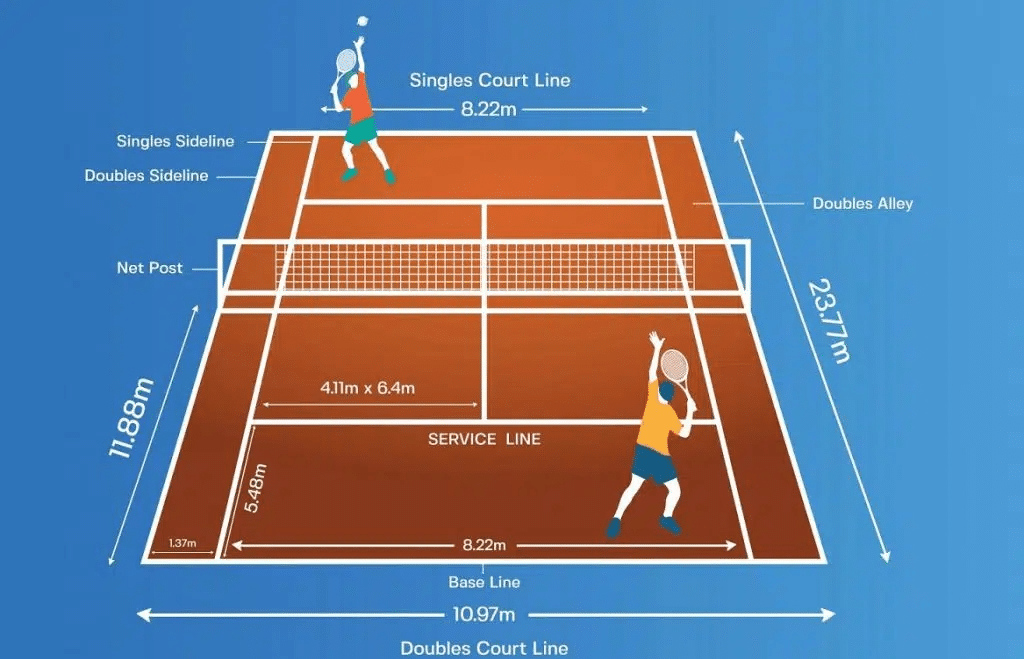
Tennis Court Dimensions
Tennis court lighting Light Pole Location/Height
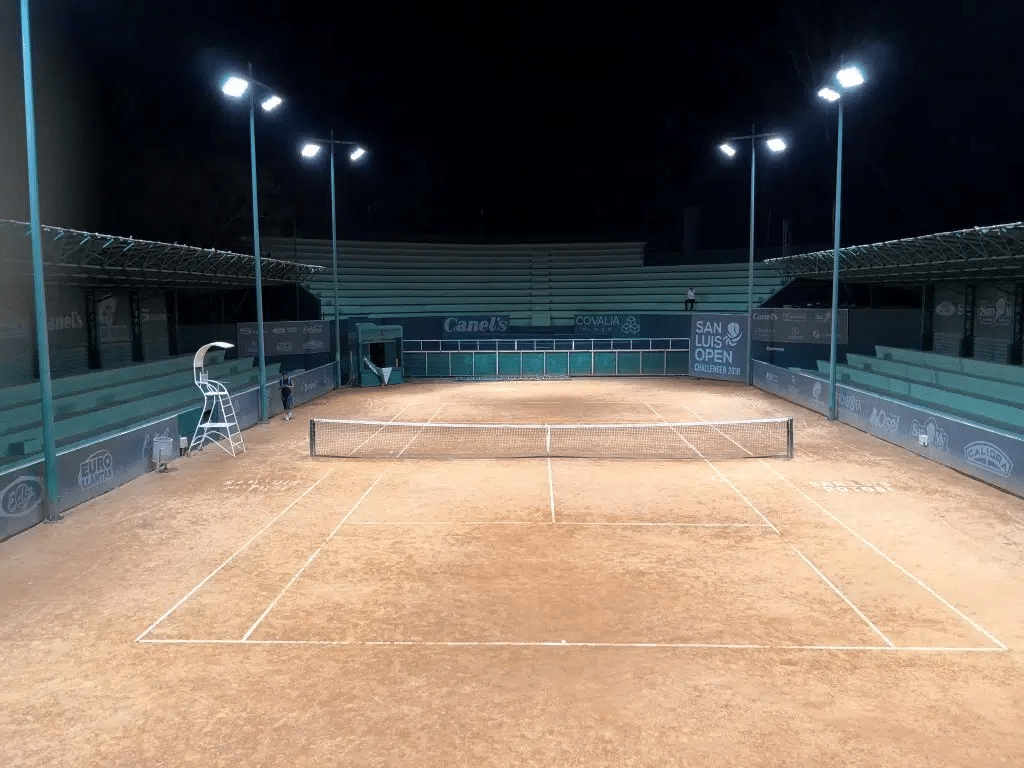
The most common light pole layout for tennis courts will usually have 4, 6 or 8 poles. The height at which the light fixtures are installed is usually 8, 10 or 12 meters. This is important as it relates to the outcome of the lighting design and the choice of LED luminaires.
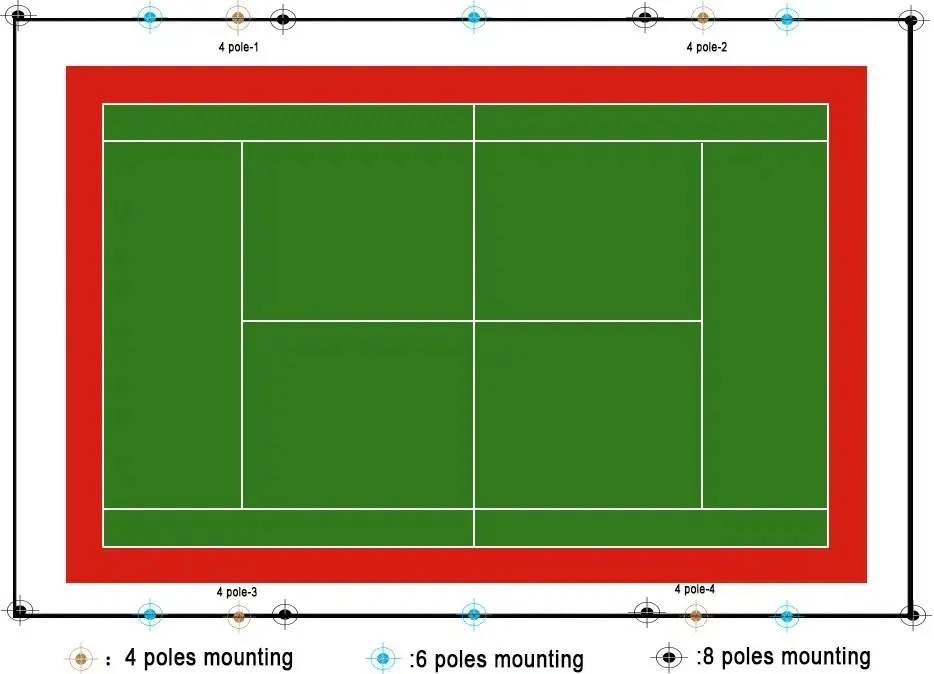
Pole position and tennis court height
Tennis court lighting Spill light
If there is only one tennis court, we don’t need to pay much attention to the light spill. However, if there are 2 or 3 or more tennis courts in a venue, we need to pay attention to the spill light from the other tennis courts.

Spillover
In addition to size, pole position/height and spill light, tennis court lighting also needs to consider illuminance rating, glare rating (GR), overall uniformity (U0), color rendering index (CRI) and color rendering rating index (Ra).
Choosing the right lighting accessories for tennis courts
In order to get a better LED lighting effect for tennis courts, we think we should focus on power, mounting bracket and lighting distribution. Therefore, we will explain these three points in this section. All content is based on outdoor tennis courts because we think once you are familiar with outdoor tennis court lighting, then moving to indoor tennis court lighting will be very easy for you.
Wattage
Make a quick selection by checking the wattage of your existing fixtures. For older stadium fixtures, high pressure sodium or metal halide lamps are typically used. To replace a 1000W high pressure sodium stadium light, a 400W LED flood light is usually sufficient. We recommend that LED floodlights can be 25% to 40% of the power of the existing high pressure sodium lamps.
Choose the power according to the lighting design
Based on the above, we have the relevant information, including the tennis court size (e.g., 40m x 20m), illuminance level (1000 lux) and 16 lamps, then we can know that the power should be at least 40 x 20 x 1000/16/160/0.8 = 390 watts. Here we assume a floodlight efficiency of 160 lumens/watt and a maintenance factor of 0.8 (for lighting design). Considering that about 20% of the light will extend outside the tennis court, the final power is about 500 watts (390/0.8). Of course, if the number of luminaires is less than 16, the power will be greater than the current value. And vice versa.
Mounting bracket
In order to be able to install the luminaires on the court without any problems, it is important to consider how the luminaires will be mounted.
Tennis court lighting distribution
An even distribution of lighting is crucial for the athletes’ experience and the spectators’ visualization. In order to illuminate a tennis court, overall uniformity is essential. This reflects the relationship between minimum and maximum illumination. Typically, a uniformity of 0.6 to 0.7 is sufficient.
According to one lighting designer, lighting distribution should be based on pole layout, pole height and court size, which means there is no uniformity. Usually, stadium lighting requires two or more lighting distributions to meet the lighting design requirements.
In addition to these factors, factors such as waterproofness, efficiency, service life, heat dissipation and warranty should also be considered when choosing LED lights for tennis courts.
Tennis court lighting Summarize
Lighting is therefore a key element of a tennis court as it relates to the skills of the players, their experience and the safety of all. All factors are crucial when choosing the best lighting solution. The size of the court, the layout of the poles, the illumination requirements and uniformity determine which fixtures and which lenses are appropriate for the site.
Standard: IEC60598
Related Products
 English
  Spanish (Spain)
  Arabic
  German
  French
  Russian
  Italian
  Portuguese
  Spanish (Mexico)
  Romanian
  Greek
Greek  Turkish
  Korean
  Hungarian
  Japanese
  Dutch
Dutch  Bulgarian
  Czech
Czech  Danish
  Slovak
  Ukrainian
  Thai
Thai  Vietnamese
  Indonesian
  Malay
Malay  Tagalog