
Exploring the Benefits and Design Steps of Golf Course Lighting
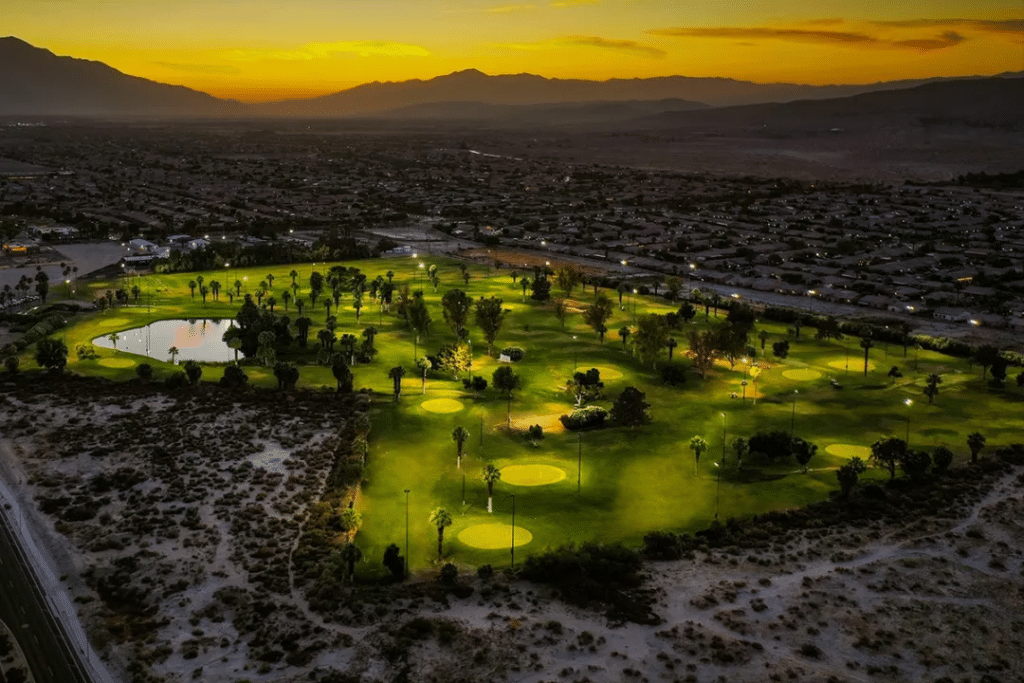
As a popular outdoor sports venue, golf courses attract many players and sports enthusiasts to enjoy their fun during the day. In order to meet their needs and provide more flexible services, many golf courses choose to open at night in order to provide better and high-quality services, which makes golf course lighting a crucial factor. It not only affects the visual effect and safety of the course, but also the practicality and economy of the course.
In order to achieve these goals, golf course lighting design becomes an indispensable tool that enables golf course lighting manufacturers and designers to accurately plan and optimize lighting systems. As a visualization tool, golf course lighting design predicts how the course will be lit under specific conditions and provides a reference for course designers. This ensures that the course lighting will provide the proper level of illumination.
This article will delve into the purpose, criteria, and steps involved in golf course lighting simulation in hopes of providing a useful reference for golf course manufacturers and designers.
Why Choose Golf Course Lighting Design?
Golf course lighting design is a key factor in the construction of a golf course, which mainly ensures the safety and functionality of the golf course at night. Golf course lighting design is vital in a number of ways, including:
Proper lighting design ensures that the lighting ultimately complies with the relevant regulations of the local government or golf association, and that the course meets safety standards, which is a prerequisite for proper course operation.
Secondly, lighting designed specifically for golf courses maximizes player safety as the lighting system fully illuminates the entire course, including tees, fairways and greens.
In addition, a brightly lit golf course creates an attractive and pleasant atmosphere that encourages players to return to the course. This helps maintain a high level of customer satisfaction, attracting repeat business and word-of-mouth.
Finally, proper lighting simulation helps the project team control costs, which is a major factor when considering lighting design. Effective lighting design guides the project team in the proper placement and selection of lighting accessories, which helps clubs and courses reduce costs. For example, the energy-saving and high-efficiency characteristics of LED lighting systems, coupled with their reasonable light distribution, make LED technology an ideal choice for golf course lighting.
In conclusion, golf course lighting design plays a key role in enhancing safety, visual quality, player experience and profitability, and is the foundation for successful course operations.
Golf Course Lighting Standards
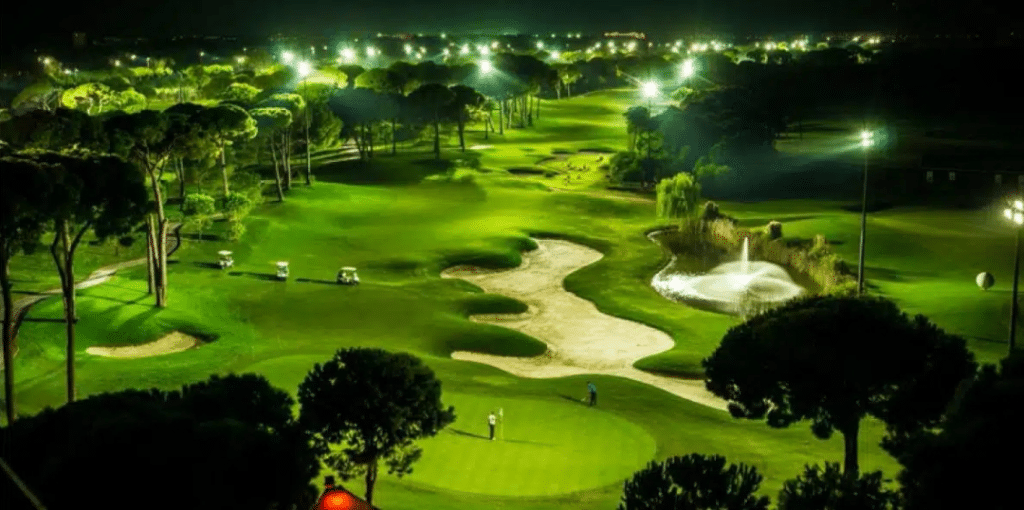
A golf course is the primary location for the entire game of golf and typically consists of 18 or more holes. Each hole is equipped with tees, fairways, greens, and different hazards (e.g., bunkers, ponds, etc.). Players are required to hit the ball into the entrance of each hole within a set number of strokes to complete the round. Golf courses are categorized into different types, such as golf courses, driving ranges, and mini golf courses. Each type has different characteristics and design requirements.
Illumination Level
Tee : 300-500 lux, to ensure that players can clearly see the ball position and swing area, and at the same time provide enough background light to observe the fairway; Fairway : 100-250 lux, to evenly cover the landing area, so that players can track the ball flight trajectory and find the landing spot. Greens: 300-500+ lux, key areas! Need high illumination to see the hole, slope and subtle grass pattern, the key to the putting experience; high grass area/hurdle area : 50-100 lux, auxiliary lighting, to avoid completely dark area caused by the ball lost, but should not be too bright distraction.
Uniformity of illumination
Horizontal uniformity: ≥ 0.5 (≥ 0.7 recommended for greens), to avoid dark and light patches, especially the greens need a soft transition of light, to prevent shadows from interfering with the judgment of the putting line; Vertical uniformity: ≥ 0.4, to ensure that the players to observe the flight path of the ball visual comfort, to reduce the interference of glare.
Glare Control
Uniform Glare Index (UGR): ≤ 25, achieved through the lamp shade, precise light distribution angle (recommended 25°-45° tilt angle) and installation height (usually ≥ 18 meters), to avoid direct glare on the player’s line of sight.
Color Rendering and Color Temperature
Color Rendering Index (CRI): ≥ 80, to restore the true color of the lawn (such as the blue and green tones of the green), to help players judge the terrain and grass conditions; Color Temperature (CCT): 4,000K-5,000K, close to the natural daylight, to provide a clear field of vision while reducing visual fatigue.
Golf course lighting must provide sufficient illumination to ensure that players can clearly see fairways, hazards, greens and holes.
Typically, Class III lighting levels require 30-50 lux. At the same time, uniformity is critical. Higher uniformity reduces shadows and improves visual comfort.
We also need to consider the reflectivity of surfaces in different areas (e.g., fairways, greens, grass) to ensure proper illumination levels.
There is also a need to minimize light pollution, avoid radiation of light into the surroundings, and use low color temperature lamps to reduce the impact on the natural night sky.
Golf Course Lighting Design Steps
The key steps in golf course light include golf course site analysis (including light pole locations), lighting standard selection, course modeling (including tees, fairways and greens), importing Dialux, and fixture selection and placement. Through these reasonable lighting design and planning, uniform distribution of illumination intensity can be achieved, glare can be avoided, light pollution can be reduced, and the playing level and safety standards can be met.
Efficient lighting selection and proper placement will ensure that the golf course is not only visually appealing at night, but also provides energy efficient solutions. Below we will explore the specific requirements of each step in more depth.
Golf course design: tees, fairways and greens
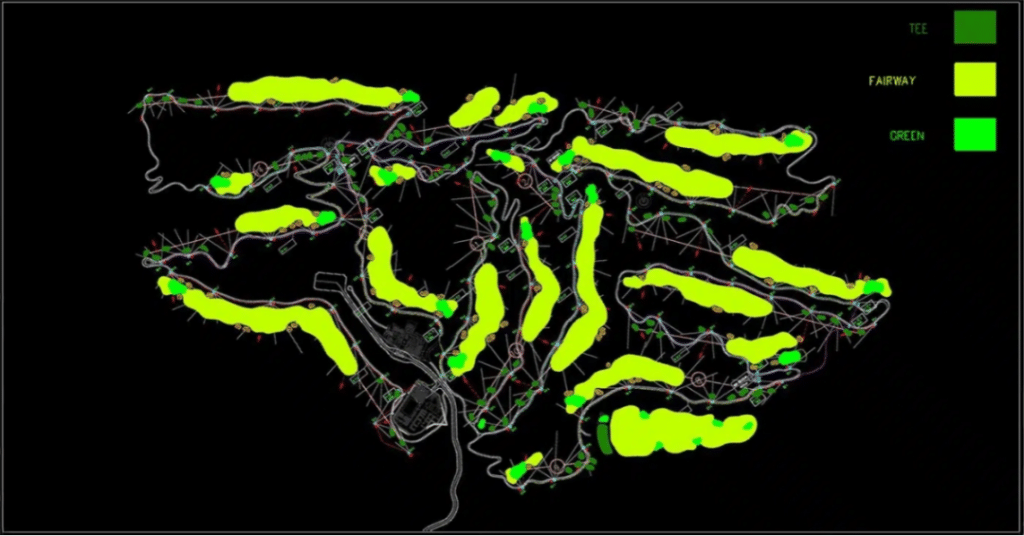
Golf courses are relatively complex and do not have a regular shape like soccer fields, basketball courts and tennis courts. Therefore, a detailed analysis of the site is required, including the size and design of the golf course, the location of tees, fairways and greens. If necessary, the impact of terrain and elevation changes on the lighting design also needs to be evaluated.
Golf Course Light Standards Selection
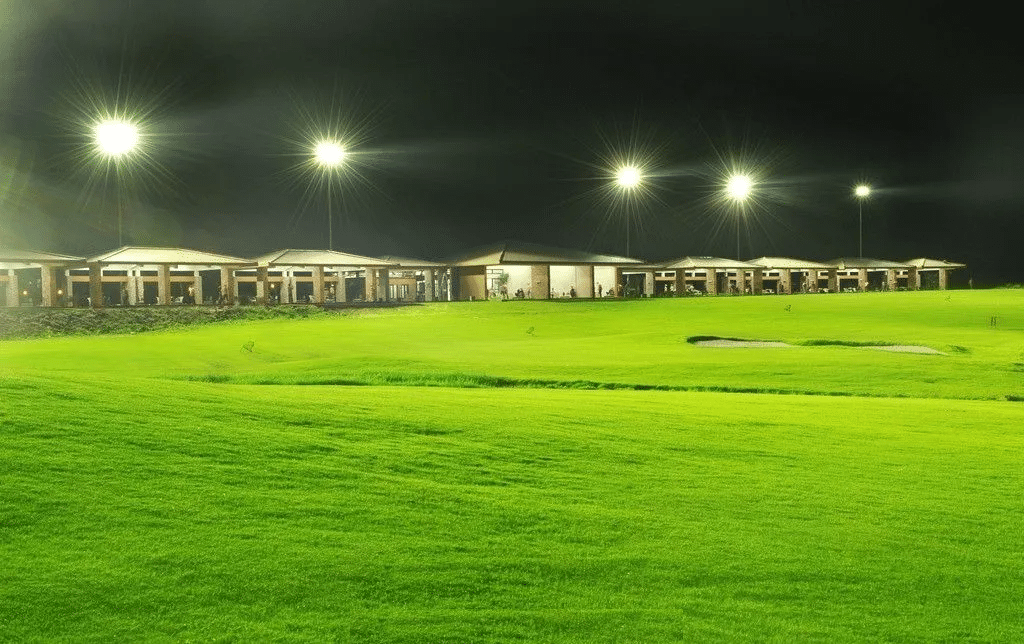
Golf course light standards should be considered based on usage, program requirements and level of play. The design should ensure safety and visual comfort while meeting the requirements of the level of play, i.e. night play. In the previous article, we introduced the relevant standards for golf course lighting. Care needs to be taken in selecting the appropriate lighting standards.
Lamp Pole Arrangement and Height
According to the location of each area of the golf course (e.g., tees, fairways, greens, bunkers, and walking paths), 3D modeling software is used to construct a digital model of the course, including elements such as terrain, vegetation, and buildings. At the same time, the location, height and orientation of the light poles are determined in conjunction with the required illumination levels, uniformity, color temperature, glare control and other factors.
Generally speaking, the height of light poles in golf courses does not need to be too high, but in order to obtain better visual effects, the height of light poles can be appropriately increased to improve uniformity and reduce glare.
Floodlight Selection and Illumination Calculation
Finally, we need to import the above scenarios (site information and light pole arrangement) into the lighting simulation software. Confirm the power, lens and number of floodlights by corresponding research and combining with lighting standards. In order to get a better lighting effect, we need to adjust the projection point of the lamps and lanterns to meet the basic lighting requirements. Through the simulation calculation of Dialux software, we can obtain the simulated lighting effect of the pitch. If the visual effect (uniformity and illuminance) of the course is not good, it needs to be adjusted in time to meet the relevant standards.
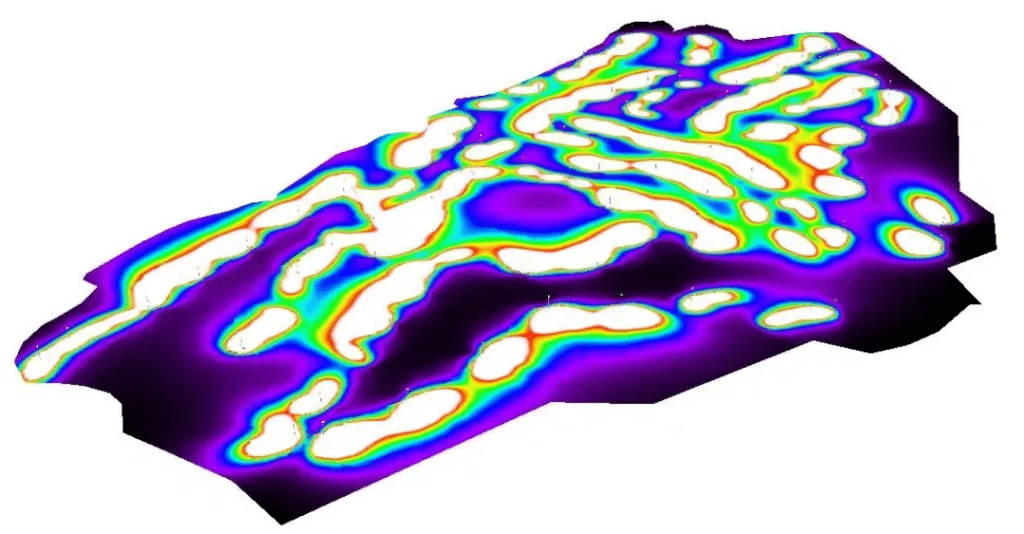
Transparent Lighting Design for Golf Courses
‘
Summary
The purpose of this article is to introduce the knowledge of golf course lighting, including why golf course lighting is needed, the importance of golf course lighting design, golf course lighting standards, and the basic steps of implementing lighting simulation. At the same time, we focus on the specific steps of golf course lighting simulation, including the selection of lighting standards, golf course design analysis, light pole height and arrangement, and LED fixture selection.
Through these contents, we have a certain understanding of golf course lighting, which helps suppliers and customers to communicate with each other more quickly and better for lighting simulation, fixture selection and project implementation.
Standard: IEC 60598
Related Products
 English
  Spanish (Spain)
  Arabic
  German
  French
  Russian
  Italian
  Portuguese
  Spanish (Mexico)
  Romanian
  Greek
Greek  Turkish
  Korean
  Hungarian
  Japanese
  Dutch
Dutch  Bulgarian
  Czech
Czech  Danish
  Slovak
  Ukrainian
  Thai
Thai  Vietnamese
  Indonesian
  Malay
Malay  Tagalog