
Soccer Stadium Lighting Solutions: A Guide to Choosing LED Lighting for Football Stadiums
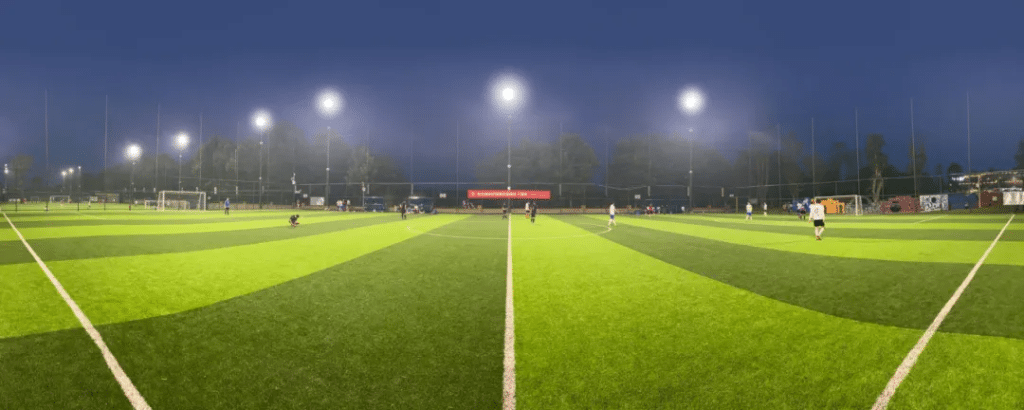
Lighting for soccer fields plays a critical role in night games. For spectators, their experience depends heavily on the configuration of the lighting system. For the players, the lighting must provide sufficient coverage to enable them to fully utilize their skills.
Soccer stadium lighting is a highly functional, technical and relatively difficult design. It not only has to meet the standards of soccer matches at all levels, but also attaches great importance to the color effects of real-time television broadcasts. In order to ensure that the broadcast picture is clear and vivid, color is true, the vertical illuminance, illumination uniformity, spatial three-dimensional sense, color temperature of the light source and the color rendering index, etc. There are corresponding provisions. Different levels of soccer field lighting standards vary. In this article, we will share this information with you.
Lighting Standards for Soccer Stadium Lighting
Lighting standards for soccer stadiums need to meet the needs of athletes, spectators and television broadcasts, involving illuminance, uniformity, glare control, color temperature and other aspects. Below are the core points of common standards from FIFA, CIE and other countries:
Illumination standard (Lux)
Illumination is a core indicator of lighting design and is divided into different levels according to the level of the match and its use:
Training/amateur matches: 100-300 lux
Amateur leagues/lower level matches: 300-500 lux
Professional matches (e.g. professional leagues): 500-750 lux
International matches (FIFA standard):
No TV broadcast: at least 500 lux (vertical illumination)
High-definition television broadcast (HDTV): main camera area: ≥1400 lux (horizontal), ≥1000 lux (vertical); average horizontal illumination of the whole field: ≥1000 lux
4K/Ultra HD broadcast: ≥2000 lux (higher uniformity required)
Uniformity
Avoid light and dark differences to ensure visual comfort and TV picture quality:
Horizontal uniformity (U₁= Emin/Emax): ≥0.7 (FIFA requires ≥0.8)
Vertical uniformity: ≥0.6 (OB requires ≥0.7)
Uniformity Gradient (UG): ≤20% variation in neighboring areas (to prevent stroboscopic)
Glare control
Glare index (GR): ≤50 (FIFA recommends ≤35), reduce direct glare by lamp shading angle, installation height (usually ≥15 meters) and light distribution design.
Color rendering and color temperature
Color rendering index (CRI): ≥80 (≥90 for OB); Color temperature (CCT): 4000K-6000K (neutral white to cool white, to ensure natural color reproduction)
Other requirements
Light source type: LED-based (energy-saving, controllable), need to avoid strobe (strobe ratio <5%).
Lighting level classification: FIFA standard: divided into VI (training) to I (international broadcasting), each level corresponds to a different illumination; EN 12193 (Europe): Class I (international matches) to Class III (amateur).
Emergency lighting: to meet the requirements for safety evacuation (≥50 lux).
Lighting for venue zones
Competition area: accent lighting, even coverage.
Spectator stand: separate design, illumination 100-200 lux to avoid interference with the playing field.
Peripheral areas: such as billboards, camera positions need to be supplemented with lighting.
International Standard References
FIFA “Football Stadiums”: detailed specification of lighting parameters and test methods.
CIE 169:2005: technical guidelines for sports lighting.
GB/T 37633-2019 (China): comprehensive event grading standards.
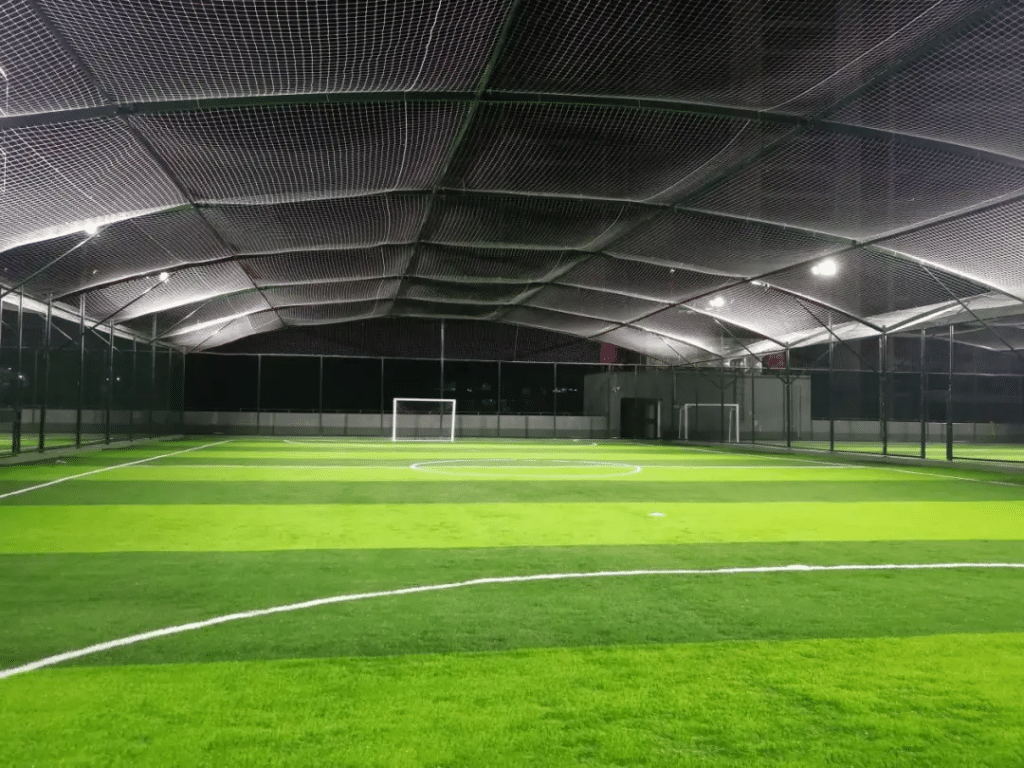
Soccer Stadium Lighting Design Guidelines
Soccer field dimensions
Most soccer fields are 105 meters long and 68 meters wide. However, depending on the use, the dimensions may vary slightly. Lengths range from 90 meters to 120 meters and widths range from 45 meters to 90 meters.
Soccer Stadium Lighting Luminaire Arrangement
Typically, LED floodlights are installed around the structure at the edge of the stadium roof. However, for some soccer stadiums, the luminaires are mounted on lampposts/pylons around the field. FIFA has set detailed requirements for this, including room edge lighting, behind goal line luminaires, luminaire focus points, and lamp post locations.
Soccer Stadium Lighting Lamp post arrangement methods
Four-corner lamps: Applicable scene: Applicable to all kinds of soccer stadiums, especially professional venues with TV broadcasting needs. Layout requirements: the lamp post should be arranged outside the four corners, to ensure that does not interfere with the player’s line of sight; no TV broadcast, 5 ° outside the center sideline and 10 ° outside the bottom line for the minimum layout angle;
when there is a TV broadcast, the angle outside the bottom line should not be less than 15 °; lamps and lanterns should not be more than 70 ° angle of projection, the shading angle should be greater than 20 °, the installation bracket tilted forward by 15 °, to avoid the upper row of lights blocking the lower row of lights.
Arrangement on both sides: light band arrangement: applicable to soccer stadiums with stands, the light band is mostly arranged in continuous or segmented. With the midpoint of the goal line as the benchmark, the bottom line on both sides of at least 15 ° can not be arranged within the lighting fixtures, the bottom line after the outward angle of 20 ° and with the horizontal plane into a 45 ° angle of the space can not be laid; multi-pole arrangement: usually multi-pole arrangement in the field of the east and west sides, the height of the light poles can be lower than the four corners of the arrangement.
To avoid visual interference with the goalkeeper and offensive players, the bottom line on both sides of at least 10 ° angle can not be arranged within the lamp post (15 ° when there is a television broadcast).
Calculation of lamp post height
Calculation formula: lamp post height h = center point to lamp post distance d × angle tangent tanØ, where Ø ≥ 25 °.
Suggestions for lamp post height for different venues:
5-a-side soccer field
Field size: length 25-42m, width 15-25m.
Lamp post height: generally 6-8 meters is appropriate, installed in the upper part of the human line of sight position, such as soccer field around the fence, the lamp post can be installed with the fence.
7-a-side soccer field
Field size: length 65-68m, width 45-48m.
Height of lamp post: common height of 12-18 meters, according to the size of the field and lighting needs to adjust.
11-a-side soccer field
Field size: length 90-120m, width 45-90m; international match standard size length 105-110m, width 68-75m.
Lamp post height: common height is 15-25m, for standard stadium with running track, the height can be increased to 35m or 40m.
Lamp selection
The light source mostly adopts LED anti-glare lamps, which have the characteristics of anti-glare, non-glare, and clear reflection. Adopt integrated flat light-emitting lamps and lanterns, the power of the light source is selected according to the height of the lamps and lanterns, the density of the lamps and lanterns and the light demand, such as 200W-400W LED lamps and lanterns.
Safety requirements
Any lighting facilities and buildings shall not be installed within 5m outside the perimeter of the stadium to ensure the safety of the players. The design of the pre-embedded parts of the light pole should be scientific and reasonable to ensure the stability and wind resistance of the light pole.
Grouping control
According to different game levels, the lights can be controlled in groups to meet different lighting requirements.
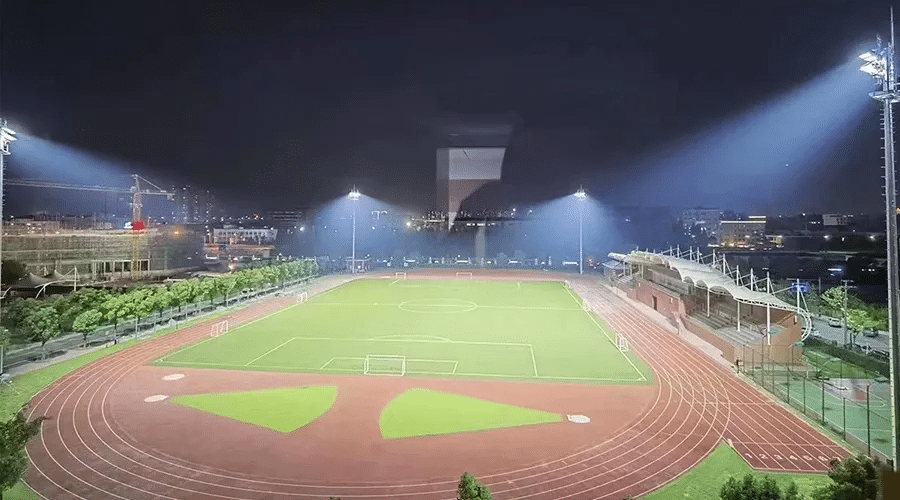
Uniformity
One of the key elements of the lighting system is the uniformity of illumination in all reference planes of the soccer field. Illumination uniformity can be defined as the degree of uniformity of light distribution on a given reference plane. Uniformity requirements for different levels of venues can be found in the Lighting Requirements Criteria section.
Illumination uniformity is the ratio of the minimum illuminance to the average illuminance on a given surface. The greater the value, the more uniform the light distribution and the more comfortable the visual experience. Experience has shown that the uniformity value calculated during the design process is a good guide, but is usually higher than the value measured after the installation of the actual lighting system. Therefore, FIFA recommends that the illuminance uniformity value calculated during the design process should be higher than the minimum requirement to take into account the possibility of a decrease in the actual measured value.
Glare
Glare is a visual condition that causes visual discomfort and reduces the visibility of objects due to improper distribution of luminance in space or time or excessive luminance contrast. Glare in the visual field to which the eye cannot adjust can cause discomfort, unpleasantness and even loss of vision. Also, glare is an important cause of visual fatigue.
The uncomfortable glare in soccer stadiums is caused by lamps that are too bright. Therefore, we should pay more attention to the arrangement of lamps.
Glare values are related to the number of luminaires, luminaire power and luminaire location. Glare is a subjective factor and the Commission Internationale de l’Illumination (CIE) has devised a practical rating system for outdoor sports based on extensive field testing. For example, the FIFA Class A standard requires the glare index to be tested at 96 points, with each point assessed at 15° intervals, meaning that one point (360°) needs to be tested in 24 directions. The observer position should be 1.75 meters above the ground. The final result (glare value) is the maximum glare value for each observer in a given direction.
Attenuation
Soccer field illumination needs to be attenuated for different purposes such as games, training or maintenance. Below are some examples:
Mode 1: Full match mode. This means that the stadium lighting system should operate according to the specific requirements of the corresponding FIFA lighting standards.
Mode 2: Training mode. This means that the pitch lighting system should be operated at an average level illumination of 500 lux.
Mode 3: Maintenance mode. This means that the pitch lighting system should be operated with an average horizontal illuminance of 250 lux.
Strobe
Strobe is a variation in the brightness of a directly visible light source that can be caused by fluctuations in the light source itself or by external causes such as a rapidly fluctuating power supply (power strobe) or incompatibility with external dimmers. The key factor contributing to strobe is fluctuations in the output current of the LED controller.
If the LED power supply output has less ripple and noise, the strobe will be smaller. This is because any fluctuation in the current waveform can cause strobe, especially at low output attenuation levels (average illuminance E). For reference, strobe percentage FF% = 0.5 x (Emax – Emin) / E average x 100%.
Soccer Stadium Lighting Correlated Color Temperature (CCT)
Color temperature is a characteristic of visible light, expressed in absolute temperature units of Kelvin (K). It describes the feeling of warmth or coolness of light (red is warm, blue is cool). The chart below provides a guide to the range of color temperatures expected in FIFA stadiums.
Soccer Stadium Lighting Color Rendering Index (CRI)
The color rendering index indicates the quality of light and its ability to accurately reproduce the color of an object. Color rendering is expressed as a 0 to 100 Ra score in the Color Rendering Index (CRI). The higher the CRI value, the greater the ability of the light source to accurately reproduce the color of the object it illuminates.
FIFA requirements stipulate that lighting systems should have good color performance, and that the color rendering index value should be higher than Ra80 for FIFA Class A and B standards, and higher than Ra70 for FIFA Class C and D standards.
Soccer Stadium Lighting Summarize
It is vital that appropriate standards and guidelines are followed when undertaking professional pitch lighting. This article focuses on soccer stadium lighting standards and provides guidance on stadium luminaire arrangements and lamp post locations. The importance of uniformity, glare, attenuation, strobe, color temperature, and color rendering index was also emphasized. Hopefully, this information will provide some tips for your stadium lighting.
Standard: IEC60598
Related Products
 English
  Spanish (Spain)
  Arabic
  German
  French
  Russian
  Italian
  Portuguese
  Spanish (Mexico)
  Romanian
  Greek
Greek  Turkish
  Korean
  Hungarian
  Japanese
  Dutch
Dutch  Bulgarian
  Czech
Czech  Danish
  Slovak
  Ukrainian
  Thai
Thai  Vietnamese
  Indonesian
  Malay
Malay  Tagalog