
Why Hazardous Area Lighting Requires Both Explosion Containment and Flame Resistance
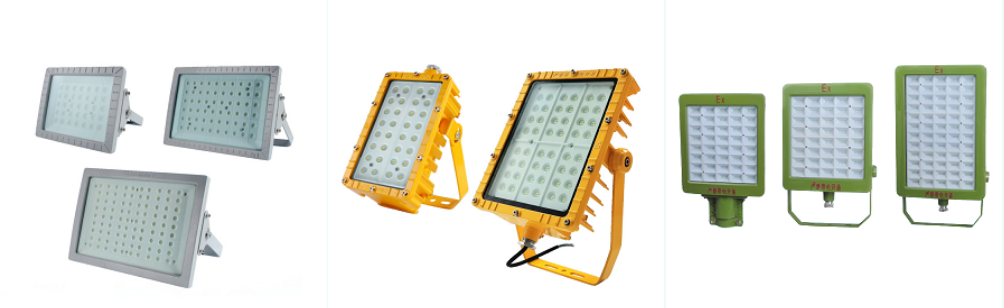
Dual-Protection Strategies for High-Risk Industrial Environments
Introduction: The Critical Role of Dual-Protection Lighting
In industries such as oil and gas, chemical processing, and mining, hazardous area lighting must address two distinct threats: internal explosive pressures and external flame propagation. While “explosion-proof” and “flame-proof” are often used interchangeably, their technical distinctions define how lighting systems safeguard facilities. This article explores why modern hazardous environments demand lighting solutions that integrate both explosion containment and flame-resistant engineering.
1. Understanding the Dual Threats in Hazardous Zones
A. Explosion Containment: Preventing Internal Ignition
Mechanism: Explosion-proof lighting seals volatile gases/dust within rugged enclosures (e.g., cast aluminum or stainless steel) designed to withstand pressures exceeding 1.5x the maximum explosive force .
Certification Standards: ATEX/IECEx Zone 1 and NEC Division 1 require enclosures to pass rigorous pressure tests (e.g., UL 1203) simulating repeated explosions .
B. Flame Resistance: Blocking External Fire Spread
Material Science: Flame-resistant coatings (e.g., ceramic or intumescent polymers) suppress combustion by absorbing heat and limiting oxygen access.
Testing Protocols: IEC 60079-0 mandates flame propagation tests, where materials must self-extinguish within 30 seconds after ignition.
Why Both Are Essential:
Scenario: In LNG storage facilities, a spark from faulty wiring could trigger an internal explosion. Without flame-resistant lens materials, escaping flames might ignite adjacent gas leaks.
2. Certification Gaps: Regional Standards Demand Dual Compliance
A. North America (NEC/UL):
Explosion-Proof Focus: UL 844 prioritizes pressure containment for Division 1 zones but lacks explicit flame-resistance criteria for Zone 22 dust environments.
Case Study: A 2024 refinery fire in Texas traced to non-compliant LED housings that resisted internal explosions but melted under external flames.
B. Europe (ATEX):
Holistic Approach: ATEX 2014/34/EU requires dual certification for Zone 1/21 areas, combining EN 60079-1 (explosion) and EN 60332-1-2 (flame retardancy).
C. Global Harmonization:
IECEx mandates dual testing for international markets, but manufacturers often overlook flame resistance in cost-driven bids, risking non-compliance in multipurpose facilities.
3. Engineering Innovations in Dual-Protection Lighting
A. Hybrid Enclosure Designs
Example: Stainless steel housings with ceramic-coated flame paths reduce heat transfer by 40% compared to traditional designs.
IoT Integration: Embedded thermal sensors monitor enclosure integrity, alerting operators to pressure leaks or coating degradation.
B. Material Breakthroughs
Polymer Composites: Flame-retardant polycarbonate lenses (tested to 800°C for 30 seconds) maintain optical clarity while blocking UV radiation.
Sealing Technologies: Conductive epoxy gaskets prevent static-induced sparks while withstanding corrosive chemicals like hydrogen sulfide.
4. Industry-Specific Applications
A. Offshore Oil Rigs (Zone 1/21):
Challenge: Saltwater corrosion weakens flame-resistant coatings.
Solution: Triple-layer anodized aluminum housings with IP66 ratings resist both explosions and marine degradation.
B. Grain Silos (Zone 22):
Risk: Combustible dust adheres to lighting surfaces, creating fire pathways.
Prevention: Electrostatic-dissipative coatings on fixtures reduce dust accumulation by 70%.
5. Maintenance Protocols for Sustained Safety
Torque Calibration: Annual checks on enclosure bolts (per ISA 60079-17) prevent pressure leaks due to loosened fasteners.
Coating Inspections: Infrared thermography identifies delamination in flame-resistant layers before failures occur.
6. Future Trends: Smart Lighting & Sustainable Materials
Self-Healing Coatings: Microcapsules in polymer matrices automatically repair cracks caused by thermal cycling.
Bio-Based Flame Retardants: Lignin-derived additives reduce reliance on toxic halogenated compounds.
Related Products
 English
  Spanish (Spain)
  Arabic
  German
  French
  Russian
  Italian
  Portuguese
  Spanish (Mexico)
  Romanian
  Greek
Greek  Turkish
  Korean
  Hungarian
  Japanese
  Dutch
Dutch  Bulgarian
  Czech
Czech  Danish
  Slovak
  Ukrainian
  Thai
Thai  Vietnamese
  Indonesian
  Malay
Malay  Tagalog